Do gravitational waves travel at the speed of light?
Yes. In 2017 the gravitational waves and gamma rays of a neutron star merger arrived 1.7 seconds apart after a 130-million-year trip. What that proved.
By The Orbital Record editorial teamPublished Last reviewed
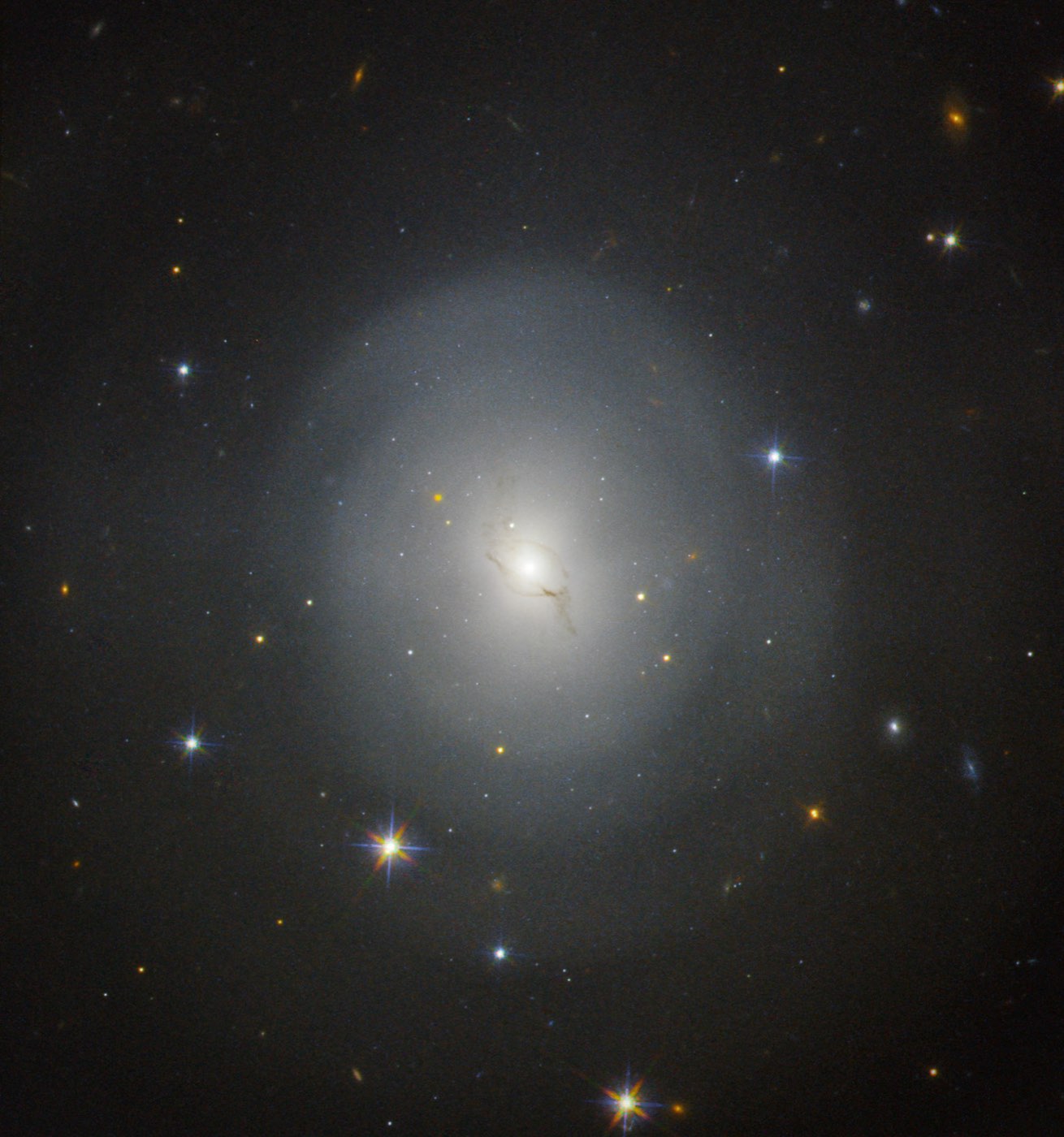
Yes: gravitational waves travel at the speed of light, as general relativity predicts. The proof came on August 17, 2017, when the merger GW170817 sent both gravitational waves and gamma rays toward Earth from about 130 million light-years away. They arrived 1.74 seconds apart, which limits any difference between the speed of gravity and the speed of light to about one part in 1015.
That one measurement settled a century-old prediction and erased a whole class of theories about dark energy. For the bigger picture, see our gravitational waves guide.
Why should gravity travel at the speed of light?
In Albert Einstein’s general relativity, completed in 1915, gravity is the curvature of spacetime (Einstein’s field equations). When masses move, the curvature changes, and those changes ripple outward as gravitational waves. The theory says they move at the same speed as light, the universal speed limit c, about 299,792 kilometers per second.
That speed matters for a simple reason: it means gravity is not instant. If the Sun vanished, Earth would keep orbiting its empty position for about eight minutes and 20 seconds, the light-travel time, before feeling any change. But until 2017, nobody had measured the speed of gravitational waves directly, and some serious alternatives to Einstein’s theory predicted a different value.
How GW170817 measured the speed of gravity
GW170817 was the first neutron star merger detected in gravitational waves, and the first event seen in both gravitational waves and light (GW170817). LIGO and Virgo, today part of the LIGO-Virgo-KAGRA network, recorded the merger signal at 12:41:04 UTC. NASA’s Fermi Gamma-ray Burst Monitor, and the European INTEGRAL satellite, detected a short gamma-ray burst, GRB 170817A, from the same patch of sky.
A joint paper by the LIGO and Virgo collaborations with the Fermi and INTEGRAL teams, published in The Astrophysical Journal Letters on October 20, 2017, did the arithmetic:
- The delay: the gamma rays arrived 1.74 seconds (plus or minus 0.05) after the merger time measured from the gravitational waves.
- The distance: to be conservative, the team used 26 megaparsecs, about 85 million light-years, the near end of the distance range allowed by the gravitational-wave data. A shorter distance gives a looser, safer limit.
- The chance of coincidence: the probability that an unrelated gamma-ray burst happened at the same time and place by accident was 5.0 × 10⁻⁸, so the two signals came from the same event.
Spread over tens of millions of years of travel, a delay of under two seconds is tiny. If the speeds differed even slightly, the gap would have been enormous.
The result: how equal are the two speeds?
The answer depends on when the gamma rays left the merger, which nobody knows exactly. The team bracketed it with two assumptions:
| Assumption | What it implies | Bound on the speed difference |
|---|---|---|
| Gamma rays and gravitational waves left at the same moment | All 1.74 seconds of delay is because gravity traveled faster | Gravity at most 7 × 10-16 (0.00000000000007%) faster than light |
| Gamma rays left 10 seconds after the merger | Gravity would have had to travel slightly slower to arrive only 1.74 seconds earlier | Gravity at most 3 × 10-15 slower than light |
Source: LIGO Scientific Collaboration, Virgo Collaboration, Fermi GBM and INTEGRAL, ApJL 848, L13 (2017).
So the speed of gravity and the speed of light are equal to within a few parts in 1015. It was possible only because, for the first time, a gravitational-wave source had been tied to a flash of light.
The 1.74-second gap itself is not evidence of a speed difference. The gamma rays need not have left at the instant of merger, which is why the analysis covered emission delays of up to 10 seconds.
Other tests in the same measurement
The same pair of signals tested two more pieces of fundamental physics:
- Lorentz invariance, the principle that the laws of physics look the same in every direction and for every steadily moving observer. The paper placed new bounds on violations of it in gravity.
- The equivalence principle. Both signals passed through the Milky Way’s gravity, which delays anything traveling past mass (the Shapiro delay). Gravitational waves and light were delayed by the same amount, as Einstein’s theory requires.
What it did to dark energy theories
The most dramatic consequence was for cosmology. Dark energy, the unknown cause of the accelerating expansion of the universe, is usually modeled as Einstein’s cosmological constant. Many alternatives instead modify gravity itself, and a large family of them, scalar-tensor theories such as the covariant Galileon, predicted that today gravitational waves would travel at a speed different from light’s.
On the day of the announcement, October 16, 2017, two papers posted to arXiv did the accounting. Ezquiaga and Zumalacárregui, in Physical Review Letters (December 2017), concluded that the result eliminates any late-universe role for covariant Galileons and for most of their broader “Horndeski” and “beyond Horndeski” generalizations, and extends to other theories predicting a variable speed of gravity, including some MOND-like ones. Creminelli and Vernizzi, in the same journal, showed the surviving theories are dramatically simplified. A single event cut through years of theory. Our dark energy guide covers what remains in play, including the DESI hints that dark energy may be weakening.
What comes next
More neutron star mergers seen in both gravitational waves and light would repeat the test with different distances and delays, and help with another use of these events: measuring the expansion rate of the universe as “standard sirens”, an independent check on the Hubble tension. As of October 2026, GW170817 is still the only merger with a confirmed light counterpart. Why such events are rare, and what they forge, is explained in our explainer on neutron star mergers.
Questions people ask
What is the speed of gravity?
As far as anyone can measure, the speed of gravity equals the speed of light, about 299,792 kilometers per second. General relativity predicts this, and in 2017 the neutron star merger GW170817 confirmed it: any difference between the two speeds is smaller than about one part in a thousand trillion.
Is gravity faster than light?
No. Changes in gravity, carried by gravitational waves, travel at the speed of light, not faster. The 2017 measurement limited gravitational waves to at most 7 parts in 10,000 trillion faster than light, and at most 3 parts in 1,000 trillion slower. Nothing in the data suggests gravity outruns light.
If the Sun disappeared, when would Earth feel it?
About eight minutes and 20 seconds later, the same time sunlight takes to reach us. Because changes in gravity travel at the speed of light, Earth would keep orbiting the empty point where the Sun had been until the news arrived, and the sky would go dark at the same moment.
Why did the gamma rays arrive 1.7 seconds after the gravitational waves?
The gap does not mean light is slower. The gamma rays need not have left at the exact instant the neutron stars merged, and nobody knows the precise emission time. The 2017 analysis therefore allowed for gamma rays emitted anywhere from the moment of merger to 10 seconds afterward when setting its limits.
How did GW170817 affect theories of dark energy?
It ruled out many of them. A large family of modified-gravity theories, proposed to explain cosmic acceleration without a cosmological constant, predicted that gravitational waves would travel at a different speed from light today. Studies published in December 2017 showed that the equal speeds eliminate covariant Galileons and much of the broader Horndeski family for late-universe cosmology.
Can gravitational waves be slowed down?
In general relativity, no medium slows gravitational waves the way glass slows light, because they interact so weakly with matter. They can be bent and delayed by gravity itself, just as light is. The 2017 analysis used that effect, the Shapiro delay, to test whether gravity and light are delayed equally by the Milky Way.