Neutron stars
A neutron star is the collapsed core of a massive star: more mass than the Sun in a ball about 20 km across. How they form, pulsars, magnetars, and limits.
By The Orbital Record editorial teamPublished Last reviewed
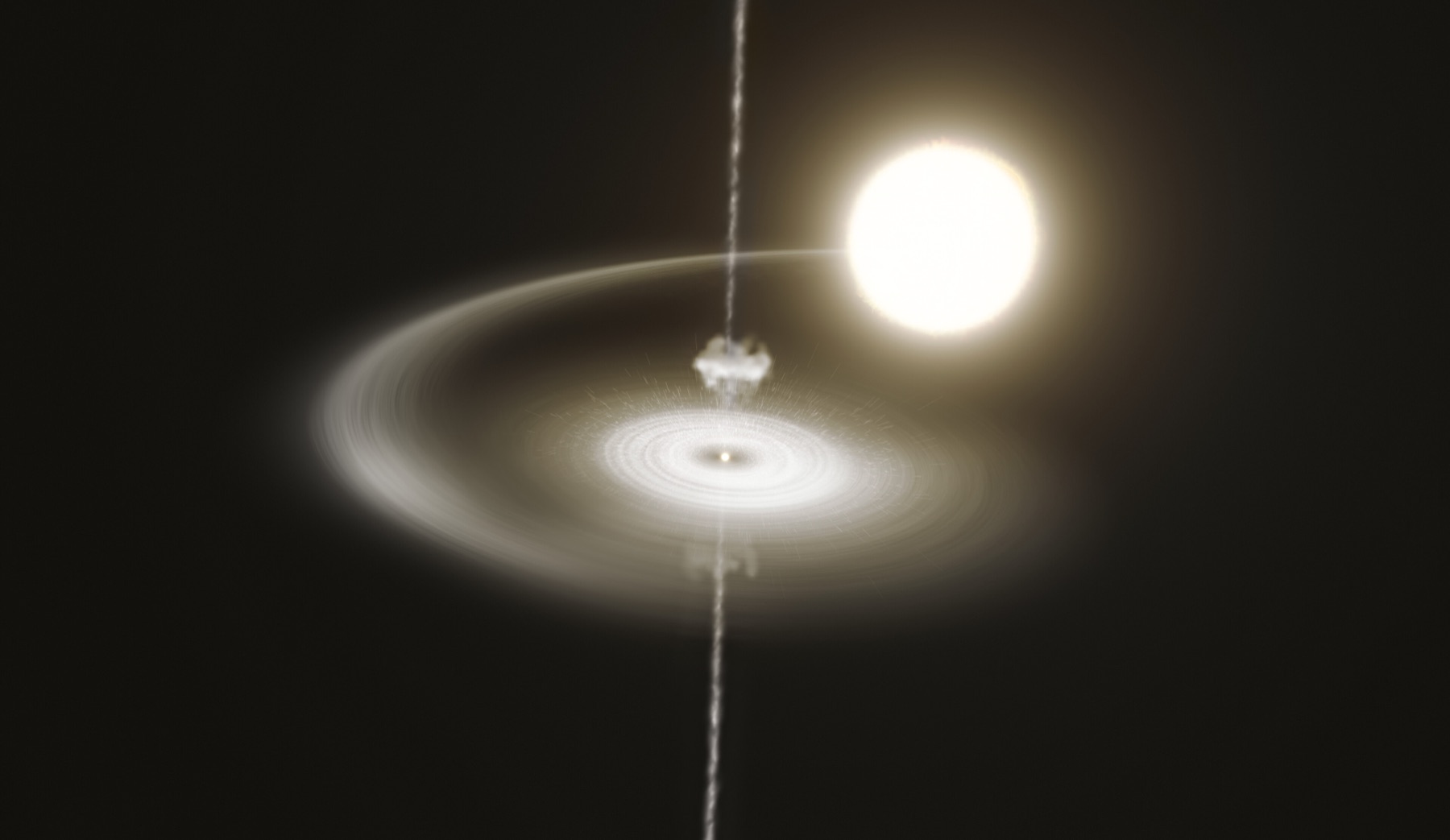
A neutron star is the collapsed core of a massive star that exploded as a supernova: more mass than the Sun, typically about 1.4 solar masses, crushed into a sphere about 20 kilometers across. Its matter is so dense that a teaspoon would weigh about a billion tons on Earth. Pulsars and magnetars are neutron stars, and they are the densest objects known short of black holes.
Neutron stars are one of three possible endings for a star, alongside white dwarfs and black holes. For the full life cycle, see our stars guide.
How do neutron stars form?
Neutron stars form when stars of roughly 8 to 20 times the Sun’s mass run out of fuel, according to NASA. The core, now iron that cannot fuse further, collapses in a fraction of a second. Electrons are forced into protons, turning them into neutrons, and the collapse stops when the neutrons are packed as tightly as in an atomic nucleus. The rebound and a flood of neutrinos blow the rest of the star apart as a core-collapse supernova. Heavier stars tend to leave black holes instead.
Walter Baade and Fritz Zwicky predicted this in 1934, in the same papers that coined the word “super-novae”: “with all reserve”, they wrote, a supernova may represent “the transition of an ordinary star into a neutron star” (Baade and Zwicky 1934). The idea stayed speculative for more than three decades.
Pulsars: how neutron stars were found
The first neutron stars were found by accident. In 1967 Jocelyn Bell, a graduate student at Cambridge, noticed a radio source pulsing every 1.337 seconds with clock-like regularity. The discovery paper appeared in Nature in February 1968 (the discovery of pulsars), and within a year pulsars were interpreted as spinning neutron stars. Antony Hewish shared the 1974 Nobel Prize in Physics for “his decisive role in the discovery of pulsars”; Bell’s exclusion became one of the best-known credit controversies in science.
A pulsar is a neutron star whose magnetic field channels beams of radiation from its poles. As the star spins, the beams sweep across Earth like a lighthouse. The catalog maintained by CSIRO in Australia lists 4,503 pulsars as of its current version. The fastest known, PSR J1748-2446ad in the star cluster Terzan 5, spins 716 times a second (Hessels et al. 2006).
Pulsars became precision tools. The Hulse-Taylor binary pulsar gave the first evidence of gravitational waves (the Hulse-Taylor binary pulsar), and arrays of millisecond pulsars now detect a background of very long gravitational waves.
How big and how heavy is a neutron star?
Measuring a neutron star’s size is hard, because it is a 20-kilometer object thousands of light-years away. NASA’s NICER X-ray instrument on the International Space Station did it by modeling hot spots on spinning pulsars:
| Neutron star | Mass (Suns) | Radius | How measured |
|---|---|---|---|
| PSR J0030+0451 | About 1.34 to 1.44 | About 12.7 to 13 km | NICER X-ray hot spots (two teams, 2019) |
| PSR J0740+6620 | 2.08 | About 12.4 to 13.7 km | Radio timing (mass) and NICER (radius), 2021 |
| PSR J0952-0607 | 2.35 (plus or minus 0.17) | Not measured | Optical study of its companion, 2022 |
Sources: Riley et al. and Miller et al. 2019 and 2021; Fonseca et al. 2021; Romani et al. 2022 (all The Astrophysical Journal Letters).
The surprise is that PSR J0740+6620, almost 50% heavier than PSR J0030+0451, is essentially the same size. That tells physicists how “squeezable” neutron star matter is, a property of nuclear physics that no laboratory on Earth can reach.
Is there a maximum mass?
Yes, but nobody knows exactly where it is. Above some limit, neutron pressure cannot hold the star up and it collapses into a black hole. Analyses of the GW170817 merger suggested a ceiling around 2.2 solar masses, while the 2.35-solar-mass PSR J0952-0607 implies the limit is at least about 2.2. A safe statement, as of October 2026: the maximum lies somewhere a little above 2.2 solar masses.
Neutron star vs black hole
| Neutron star | Black hole | |
|---|---|---|
| What holds it up | Pressure of packed neutrons | Nothing: complete collapse |
| Surface | Yes, a solid crust | No, an event horizon |
| Typical mass | About 1.4 Suns; up to about 2.3 measured | From about 3 Suns up (stellar) |
| Size | About 20 to 25 km across | About 6 km per 1 Sun of mass (horizon diameter) |
| Light | Can emit radio, X-rays, gamma rays from its surface and beams | No light from inside; glow comes from surrounding gas |
| Can it spin and pulse? | Yes, as a pulsar | No pulses |
The horizon size follows from the Schwarzschild radius, about 3 kilometers per solar mass. A neutron star is only a few times larger than a black hole of the same mass, which is why it sits just one step from collapse. More in our black holes guide.
Magnetars: the strongest magnets in the universe
A magnetar is a neutron star with a magnetic field of about 100 trillion to a quadrillion (1015) gauss, according to NASA, up to a thousand times stronger than an ordinary neutron star’s. Magnetars release sudden flares of X-rays and gamma rays as their fields rearrange. In October 2026 JWST found that the most distant fast radio burst yet came from a young host galaxy, supporting the idea that some bursts come from young magnetars (the most distant fast radio burst).
When neutron stars collide
Pairs of neutron stars slowly spiral together by emitting gravitational waves. In 2017 LIGO and Virgo caught the final collision of two of them, GW170817, and telescopes saw the explosion that followed, a kilonova that forged heavy elements such as gold (GW170817). Our explainer on neutron star mergers tells that story. Lighter stars end very differently, as Earth-sized white dwarfs.
Questions people ask
What is a neutron star?
A neutron star is the collapsed core left behind when a massive star explodes as a supernova. It packs more mass than the Sun, typically about 1.4 solar masses, into a sphere about 20 kilometers across, so dense that its matter is made mostly of neutrons. Pulsars and magnetars are kinds of neutron stars.
How dense is a neutron star?
So dense that, according to NASA, a teaspoon of neutron star matter would weigh about a billion tons on Earth. A neutron star squeezes more than the Sun's mass into a ball the size of a city, close to the density of an atomic nucleus. It is the densest matter known outside a black hole.
What is the difference between a neutron star and a black hole?
Both are the remains of massive stars, but a neutron star has a surface and is held up by the pressure of packed neutrons, while a black hole has collapsed completely behind an event horizon. Neutron stars top out at a little over two solar masses; anything heavier collapses into a black hole.
What is a magnetar?
A magnetar is a neutron star with an extreme magnetic field, from about 100 trillion to a quadrillion gauss, according to NASA, up to a thousand times stronger than a typical neutron star's. Magnetars release violent flares of X-rays and gamma rays, and some fast radio bursts are thought to come from young magnetars.
What is the heaviest neutron star?
The heaviest well-measured neutron star is PSR J0952-0607, at 2.35 solar masses (plus or minus 0.17), measured in 2022. The heaviest measured with the most precise radio timing method is PSR J0740+6620, at 2.08 solar masses. The true maximum mass is uncertain but seems to lie above about 2.2.
How many neutron stars are known?
The catalog maintained by Australia's CSIRO lists 4,503 pulsars, the most commonly detected neutron stars, as of its October 2026 version. Many more neutron stars must exist in the Milky Way, because most are too old, slow or badly aligned for their beams to reach Earth.
Can a neutron star turn into a black hole?
Yes, if it gains enough mass. Theory predicts that a neutron star pushed above its maximum mass, by swallowing gas from a companion or by merging with another neutron star, can no longer be supported by neutron pressure and collapses into a black hole. Exactly where that limit lies is still being measured.