3I/ATLAS
3I/ATLAS is the third interstellar object ever found, a comet likely far older than the Sun. What it is, a dated timeline, and what the evidence says.
By The Orbital Record editorial teamPublished Last reviewed
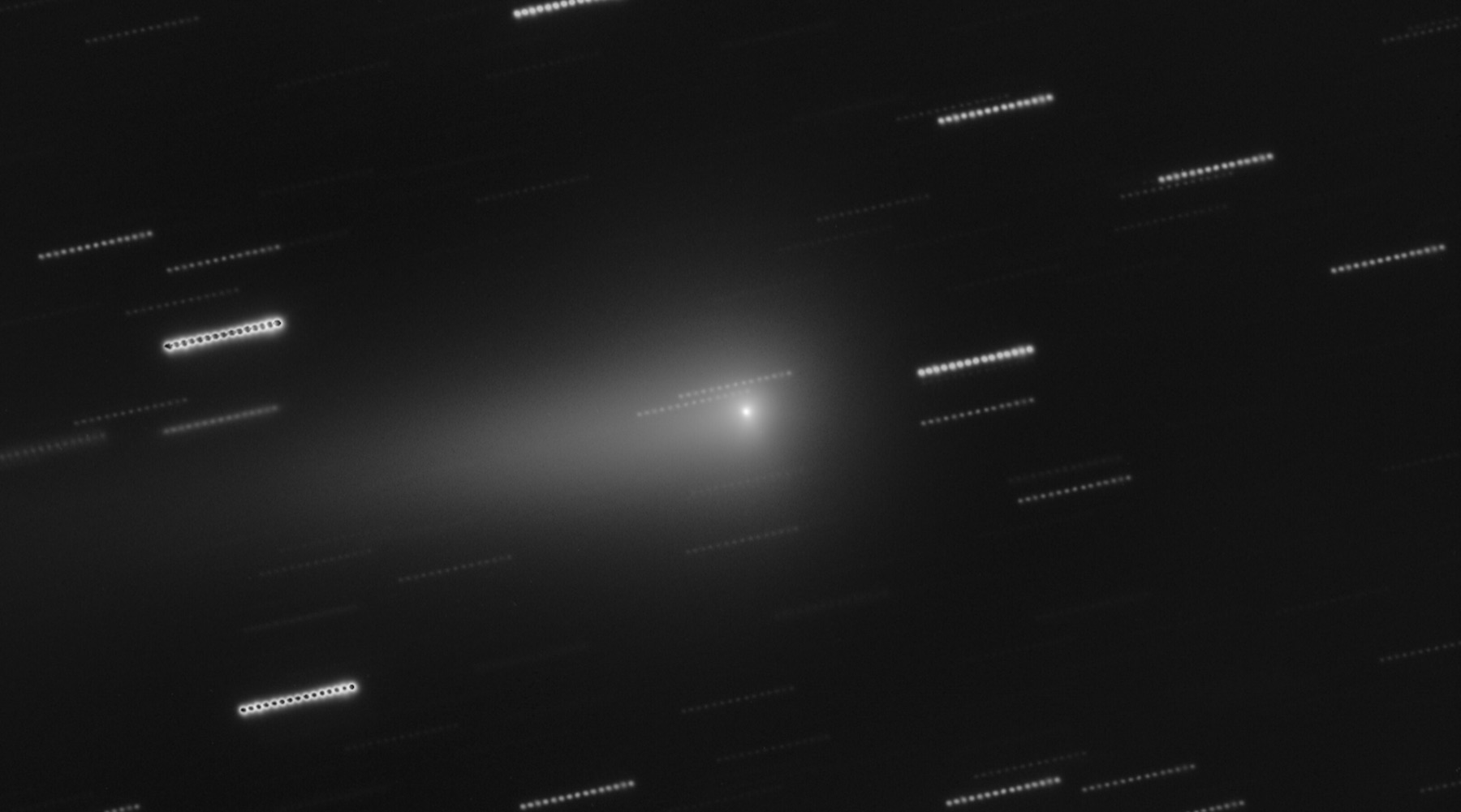
3I/ATLAS is an interstellar comet, the third object from another star system ever seen passing through ours. It was discovered on July 1, 2025, by the ATLAS survey in Chile, swung closest to the Sun around October 29 to 30, 2025, and is now heading back to interstellar space. Its chemistry suggests it formed around a star billions of years older than the Sun.
It was the most-read astronomy story of the past year, and much of the coverage mixed real measurements with speculation about alien technology. This page sticks to the evidence, with dates, and explains where it fits among the visitors from other stars that cross the solar system.
3I/ATLAS at a glance
| Property | Value | Source |
|---|---|---|
| Designations | 3I/ATLAS, C/2025 N1 (ATLAS) | Minor Planet Center, 2 July 2025 |
| Discovered | 1 July 2025, ATLAS telescope, Río Hurtado, Chile | MPEC 2025-N12 |
| Eccentricity | About 6.1 (above 1 means unbound) | JPL orbit solution |
| Speed far from the Sun | About 58 km/s | Seligman et al. 2025 |
| Closest to the Sun | Around 29 to 30 October 2025, about 1.36 AU | JPL; NASA |
| Closest to Earth | 19 December 2025, about 1.8 AU | JPL |
| Nucleus | Radius between about 0.2 and 2.8 km | Jewitt et al. 2025 (Hubble) |
| Age | Likely older than 7 billion years | Hopkins et al. 2025; Opitom et al. 2026 |
An astronomical unit (AU) is the average Earth-Sun distance, about 150 million kilometers.
Timeline
Discovery, summer 2025
- 1 July 2025. The NASA-funded ATLAS telescope at Río Hurtado, Chile, picks up a moving object in four 30-second survey images.
- 2 July 2025. The Minor Planet Center announces “3I/ATLAS = C/2025 N1 (ATLAS).” The “3I” means third interstellar object. Its orbit is strongly hyperbolic: it is not bound to the Sun.
- July 2025. Searches of archives find earlier images. NASA’s TESS satellite had recorded it in May 2025, and other survey data show the comet was already active far from the Sun.
- August 2025. Hubble constrains the solid nucleus to a radius between about 0.2 and 2.8 kilometers (Jewitt et al. 2025). The James Webb Space Telescope finds a coma dominated by carbon dioxide, with water, carbon monoxide and water ice (Cordiner et al. 2025). ESO’s Very Large Telescope detects nickel vapor and cyanide gas (Rahatgaonkar et al. 2025).
Mars flyby and perihelion, autumn 2025
- 2 to 4 October 2025. The comet passes about 0.19 AU (roughly 29 million kilometers) from Mars on October 3. ESA’s ExoMars Trace Gas Orbiter images its coma; NASA’s Mars Reconnaissance Orbiter and the Perseverance rover also observe it.
- Late September to late November 2025. The comet is too close to the Sun in the sky for most telescopes. Solar coronagraphs on STEREO-A, SOHO and GOES-19 keep tracking it and record a steep brightening as it nears the Sun.
- Around 29 to 30 October 2025. Perihelion, the closest point to the Sun, at about 1.36 AU, just inside the orbit of Mars.
- 2 to 25 November 2025. ESA’s Juice spacecraft, en route to Jupiter, observes from about 60 million kilometers and detects water and carbon dioxide.
- 19 November 2025. NASA releases images from more than 20 missions and states the object is behaving as a comet.
Outbound, 2026
- 19 December 2025. Closest approach to Earth, about 1.8 AU. No risk to Earth at any point.
- 16 March 2026. Closest approach to Jupiter, about 0.36 AU.
- June 2026. A team led by Martin Cordiner reports in Nature that JWST measured very high deuterium and low carbon-13 levels, pointing to formation roughly 10 to 12 billion years ago.
- 6 July 2026. A team led by Cyrielle Opitom reports in Nature Astronomy that carbon and nitrogen isotope ratios in the comet’s cyanide gas are far higher than in solar system comets, consistent with an old, metal-poor star system (3I/ATLAS likely formed around a star much older than the Sun).
- October 2026. The comet is more than 12 AU from the Sun, beyond Saturn’s orbit, moving away at about 59 km/s.
What 3I/ATLAS is made of
3I/ATLAS behaves like a comet: a small icy nucleus that releases gas and dust as it warms. What makes it unusual is the mix.
- Very rich in carbon dioxide. JWST measured roughly eight carbon dioxide molecules for every water molecule in August 2025, an extreme ratio compared with typical solar system comets.
- Nickel before iron. The VLT saw nickel vapor long before iron, a pattern seen in some solar system comets too, possibly from metal compounds that break apart at low temperatures.
- Isotopes from another star. Its carbon-12 to carbon-13 ratio of about 151 and nitrogen-14 to nitrogen-15 ratio of about 363 compare with about 90 and 150 in solar system comets.
- Very old. A study of its trajectory by Matthew Hopkins and colleagues estimated an age above 7.6 billion years, from the Milky Way’s thick disk (Hopkins et al. 2025). If so, the comet formed billions of years before the Sun.
Is 3I/ATLAS artificial? The evidence
In July 2025, two weeks after discovery, Harvard astronomer Avi Loeb and two co-authors posted a preprint titled “Is the Interstellar Object 3I/ATLAS Alien Technology?” (Hibberd, Crowl and Loeb 2025). It noted that the comet’s path lies close to the plane of the planets and passes relatively near Venus, Mars and Jupiter, and the authors themselves described the paper as “largely a pedagogical exercise.” Loeb later listed other “anomalies” on his blog, including the sunward jet, the nickel and the acceleration.
Each of those points has a natural explanation backed by data:
| Claimed anomaly | What the observations show |
|---|---|
| Path near the plane of the planets | Its orbit is tilted about 5 degrees from the ecliptic; an unusual alignment is not evidence of steering |
| Unexplained acceleration | JPL’s orbit fits include a small push consistent with ordinary gas jets on a comet |
| Nickel without iron | Iron was later detected; nickel-rich emission is also seen in solar system comets |
| A sunward “anti-tail” | Jets on the sunlit side of comets are common and appear in other comets |
| No visible coma at first | Gas and dust were measured by JWST, Hubble, the VLT, Swift and Juice |
On November 19, 2025, NASA associate administrator for science Nicky Fox told reporters: “We certainly haven’t seen any techno signatures or anything from it that would lead us to believe it was anything other than a comet.” The International Asteroid Warning Network ran an observing campaign on the comet from late November 2025 to January 2026 as practice for tracking future objects.
Asking whether an object could be artificial is legitimate science, and it is how SETI works. The answer for 3I/ATLAS, from dozens of independent instruments, is that it is a natural comet. What makes it remarkable is its likely age and origin, not its engineering. For the bigger question of why we have not found anyone, see the Fermi paradox.
How it compares with the first two interstellar objects
| Object | Discovered | What it was | Notable |
|---|---|---|---|
| 1I/’Oumuamua | 19 Oct 2017, Pan-STARRS1, Hawaii | Small, elongated body, no visible coma | Up to about 400 m long; slight non-gravitational push (Meech et al. 2017) |
| 2I/Borisov | 30 Aug 2019, amateur Gennady Borisov | First clearly cometary interstellar object | Nucleus under about 1 km |
| 3I/ATLAS | 1 Jul 2025, ATLAS, Chile | Active comet, rich in carbon dioxide | Brightest and fastest so far; likely older than 7 billion years |
More are coming. The Vera C. Rubin Observatory, which began its ten-year survey in June 2026, is expected to find interstellar objects far more often, possibly early enough to plan a spacecraft intercept.
Sources
- Minor Planet Center (2 July 2025). MPEC 2025-N12: 3I/ATLAS = C/2025 N1 (ATLAS). https://minorplanetcenter.net/mpec/K25/K25N12.html [primary]
- Seligman, D. Z. et al. (2025). Discovery and preliminary characterization of a third interstellar object: 3I/ATLAS. https://arxiv.org/abs/2507.02757 [primary]
- Cordiner, M. A. et al. (2025). JWST detection of a carbon dioxide dominated gas coma surrounding interstellar object 3I/ATLAS. https://arxiv.org/abs/2508.18209 [primary]
- Opitom, C. et al. (2026). Nature Astronomy. https://doi.org/10.1038/s41550-026-02921-7 [primary]
- NASA, Comet 3I/ATLAS mission page. https://science.nasa.gov/solar-system/comets/3i-atlas/ [agency]
- Hibberd, A., Crowl, A. and Loeb, A. (2025). Is the Interstellar Object 3I/ATLAS Alien Technology? https://arxiv.org/abs/2507.12213 [preprint]
Questions people ask
What is 3I/ATLAS?
3I/ATLAS is a comet from another star system, the third interstellar object ever detected after 'Oumuamua in 2017 and Borisov in 2019. It was discovered on July 1, 2025, by the ATLAS survey telescope in Chile, passed closest to the Sun in late October 2025, and is now leaving the solar system for good.
Is 3I/ATLAS an alien spacecraft?
No evidence supports that. Telescopes and spacecraft have measured a coma and tail of carbon dioxide, water, carbon monoxide, cyanide and metal vapors, all normal for a comet. NASA reported in November 2025 that it had seen no technosignatures, and its small extra acceleration matches ordinary outgassing.
How old is 3I/ATLAS?
Probably much older than the Sun. Its path suggests it comes from the Milky Way's old thick disk, with an estimated age above 7 billion years, and 2026 measurements of its carbon, nitrogen and hydrogen isotopes point to formation around an old star more than twice the Sun's age of 4.6 billion years.
How fast is 3I/ATLAS moving?
Far from the Sun it travels at about 58 kilometers per second relative to the solar system, much faster than either earlier interstellar object. That speed, together with an orbital eccentricity above 6, means the Sun's gravity can never capture it. It will leave the solar system and never return.
Did 3I/ATLAS come close to Earth?
No. Its closest approach to Earth, on December 19, 2025, was about 1.8 astronomical units, roughly 270 million kilometers, almost twice Earth's distance from the Sun. It came much closer to Mars, about 0.19 astronomical units on October 3, 2025, and spacecraft at Mars photographed it.
Can I still see 3I/ATLAS?
Not with amateur equipment. By mid-October 2026 it was more than 12 astronomical units from the Sun, beyond the orbit of Saturn, and far too faint for anything but the largest telescopes. The best views were from late 2025 to early 2026.