As of October 2026, no life beyond Earth has been confirmed. Astrobiology is the science of life’s origin, evolution and distribution in the universe, and its best targets are Mars, Europa, Enceladus and the atmospheres of exoplanets. Telescopes and missions now operating or planned could detect convincing signs of life within decades.
This guide is evidence first. It covers what would count as evidence, where the search is happening, the closest calls so far, and the big questions such as the Fermi paradox.
Is there life in the universe? The honest answer
We have exactly one confirmed example of life: Earth’s. That is the central fact of astrobiology, and it cuts both ways.
Why many scientists expect life to be common. The raw materials are everywhere. Water, organic molecules and energy sources are found across the solar system and in planet-forming disks. More than 6,000 exoplanets are confirmed, and many rocky ones orbit in habitable zones (exoplanets guide). Life also appeared on Earth relatively soon after the planet cooled. And in 1953 Stanley Miller showed that sparks in a mix of simple gases produce amino acids, the building blocks of proteins (the Miller-Urey experiment).
Why some do not. Making ingredients is not making a cell. We do not know how life began on Earth, so we cannot say how likely it is to begin elsewhere. Complex, intelligent life may require a long chain of unlikely steps. A single example cannot tell us whether life is common or a fluke.
The way out of that deadlock is to find a second, independent origin of life. That is what the rest of this guide is about.
What is astrobiology?
Astrobiology is the study of life in a cosmic context: how it began, how it evolves, where it could exist beyond Earth and how to detect it. It draws on astronomy, microbiology, chemistry, geology, oceanography and planetary science. NASA runs a dedicated Astrobiology Program, and life detection now shapes mission design from Mars rovers to space telescopes.
Astrobiology also studies life at the limits on Earth. In September 2026 researchers reported a “fire amoeba” that divides at 63 degrees Celsius, a new record for complex cells with a nucleus (fire amoeba sets a heat record). Each such extreme widens the range of places worth searching.
What counts as evidence of life? Biosignatures
A biosignature is something that could point to life: a gas, a mineral pattern, a molecule or a structure. The hard part is that almost every candidate can also be made without life. Main kinds:
- Atmospheric gases out of balance. Oxygen and methane react with each other, so finding both in abundance means something keeps replenishing them. On Earth, that is life.
- Specific gases made by life on Earth, such as dimethyl sulfide (DMS), produced by marine plankton. DMS was the focus of the disputed K2-18b claim, and it has since been found on a lifeless comet.
- Minerals and textures shaped by microbes, such as the iron phosphate and iron sulfide “leopard spots” found on Mars in 2024.
- Complex organic molecules in patterns that chemistry alone rarely produces.
- Technosignatures: radio or laser signals, industrial gases or other signs of technology.
False positives are the trap. In 1996 a team announced possible fossil microbes in the Martian meteorite ALH84001 (McKay et al. 1996), and the US president made a public statement. Later studies favored non-biological explanations. To avoid a repeat, NASA scientists proposed in 2021 a seven-step Confidence of Life Detection (CoLD) scale, from a first possible signal to independently confirmed evidence of life. No claim so far has climbed beyond the early steps.
Where to look in our solar system
Mars
Mars was warmer and wetter more than 3 billion years ago, with rivers and lakes. NASA’s Perseverance rover is exploring Jezero Crater, an ancient lake bed. In July 2024 it examined a rock nicknamed “Cheyava Falls” with millimeter-scale “leopard spots” of the minerals vivianite and greigite next to organic carbon. On Earth such patterns often form through microbial chemistry. In September 2025 NASA called the features a “potential biosignature,” meaning they might have a biological origin but need more study, and the rover sealed a core of the rock, the “Sapphire Canyon” sample (Hurowitz et al. 2025). Only laboratories on Earth could settle it.
The evidence keeps building. In April 2026 Curiosity’s team reported 21 carbon-bearing molecules in one sample, seven never before seen on Mars (Curiosity’s most diverse organic molecules), and in September 2026 Perseverance showed rocks on Jezero’s rim were altered by water at least three times (Perseverance and Jezero’s water episodes).
Europa
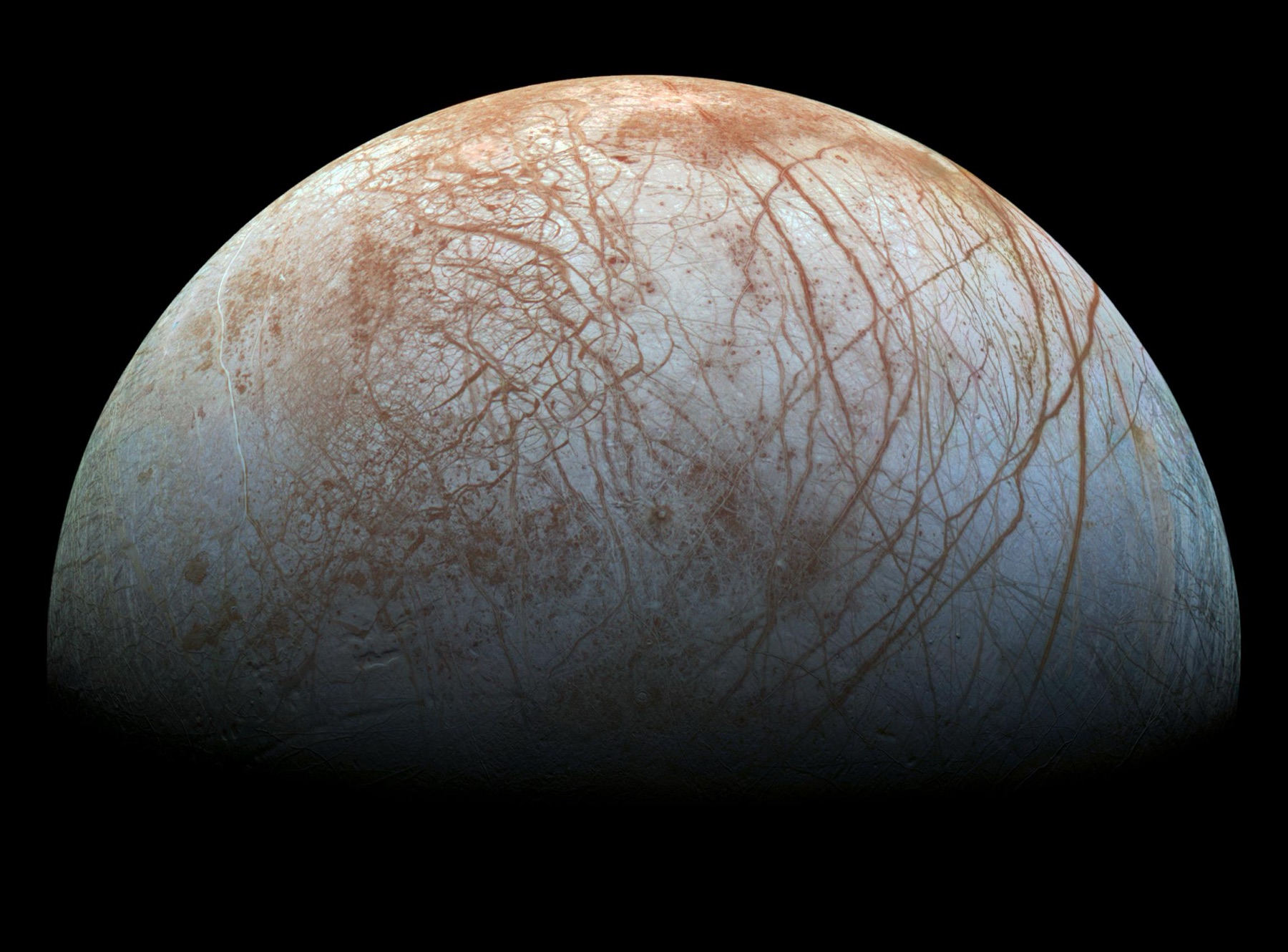
Jupiter’s moon Europa hides a global salty ocean under its ice shell, probably with more water than all of Earth’s oceans combined. NASA’s Europa Clipper launched on October 14, 2024, and will reach Jupiter in April 2030 to make dozens of close flybys. ESA’s Juice, launched in April 2023, will study Europa, Ganymede and Callisto in the 2030s. Neither can detect life directly; both will test whether the ocean is habitable. What keeps such oceans liquid so far from the Sun is tidal heating, the flexing of a moon by its giant planet’s gravity. Its most extreme example is Jupiter’s volcanic moon Io, where in 2026 the Juno spacecraft took the first temperature readings below the surface and found heat rising far faster than sunlight can explain (Juno at Io).
Enceladus
Saturn’s small moon Enceladus sprays its ocean into space through cracks near its south pole, and NASA’s Cassini spacecraft flew through the plumes. It found water with salts, organic molecules and molecular hydrogen, a sign of hydrothermal activity and a potential food source for microbes (Waite et al. 2017). In 2023 phosphates turned up in ice grains from the ocean, at concentrations far above Earth’s seas (Postberg et al. 2023). All six key elements for life as we know it have now been found or inferred there.
Titan
Saturn’s largest moon, Titan, has a thick nitrogen atmosphere, lakes of liquid methane and ethane, and rich organic chemistry, with a water ocean deep below. NASA’s Dragonfly, a nuclear-powered rotorcraft, is due to launch in July 2028 and arrive in 2034 to fly between sites and study prebiotic chemistry.
Life on exoplanets
Beyond the solar system, the only practical way to search for life is through light: the chemistry of an exoplanet’s atmosphere. The key idea is the habitable zone, the range of distances from a star where liquid water could exist on a planet’s surface, defined in its modern form by James Kasting and colleagues in 1993 (habitable zones).
Most nearby habitable-zone planets orbit red dwarfs, which flare violently and may strip away atmospheres. JWST has found that several rocky planets around such stars lack thick atmospheres, while the more promising ones are still being observed. Our ranked list of the most Earth-like exoplanets explains each candidate.
The most publicized test case is K2-18b, a sub-Neptune 124 light-years away. In 2023 JWST found methane and carbon dioxide in its atmosphere (Madhusudhan et al. 2023), and in April 2025 the same team reported a possible signal of DMS at about 3 sigma. Independent reanalyses have found the signal is not statistically significant, and the claim is unconfirmed. The dated story is in K2-18b and the search for life.
Are we alone? The Fermi paradox
If life and intelligence are common, why do we see no sign of anyone else? That is the Fermi paradox, named after physicist Enrico Fermi, who asked “where is everybody?” over lunch at Los Alamos in 1950. Proposed answers range from life being rare, to civilizations not lasting, to us simply not having searched enough. We weigh them in the Fermi paradox explained.
The Drake equation
The Drake equation, written by Frank Drake for a 1961 meeting at Green Bank, West Virginia, breaks the question “how many civilizations could we detect?” into seven factors multiplied together:
- the rate at which stars form in the Milky Way;
- the fraction of stars with planets;
- the number of planets per system that could support life;
- the fraction of those where life actually starts;
- the fraction where intelligence evolves;
- the fraction that develop technology we could detect;
- how long such civilizations remain detectable.
Sixty-five years later, the first three are measured or reasonably constrained. Exoplanet surveys showed that most stars have planets, which settled factor 2. The last four remain guesses that span many orders of magnitude, which is why published estimates range from less than one to millions.
SETI: searching for signals
The search for extraterrestrial intelligence (SETI) began with a two-page paper. In 1959 Giuseppe Cocconi and Philip Morrison argued that radio telescopes could detect signals from nearby stars and suggested listening near 1,420 megahertz, the natural frequency of hydrogen (Cocconi and Morrison 1959). In 1960 Frank Drake ran the first search, Project Ozma, pointing a Green Bank antenna at two Sun-like stars.
The most famous candidate, the “Wow!” signal recorded by Ohio State University’s Big Ear telescope on August 15, 1977, was strong and narrow, but it was never seen again and cannot be called evidence. Today the largest search is Breakthrough Listen, started in 2015, which uses radio and optical telescopes on several continents. No confirmed technosignature has been found, including in targeted searches of interstellar visitors such as the comet 3I/ATLAS.
When will we find alien life?
No one can promise a date, but the coming decades bring real, scheduled tests:
- 2030s, ocean worlds. Europa Clipper reaches Jupiter in 2030 and Juice in 2031; Dragonfly arrives at Titan in 2034.
- Early 2030s, giant telescopes. ESO’s 39-meter Extremely Large Telescope plans to begin science in December 2030 and may probe atmospheres of nearby rocky planets.
- Now, JWST. The James Webb Space Telescope keeps observing TRAPPIST-1 and other rocky worlds to see which have atmospheres at all.
- 2040s, a dedicated life finder. NASA’s proposed Habitable Worlds Observatory is designed to image Earth-like planets around Sun-like stars and read their air for oxygen, water and methane. NASA’s Roman Space Telescope, launched in August 2026, carries a coronagraph that tests the technology.
Whatever the answer, the search is producing a census of where life could exist, and that is a first in human history.
For a careful explanation of the Fermi paradox and the case for and against alien life, our video library includes Kurzgesagt’s “The Fermi Paradox: Where Are All The Aliens?”
Key papers
Where the research is happening
Sources
- Hurowitz, J. A. et al. (2025). Redox-driven mineral and organic associations in Jezero Crater, Mars. Nature 645, 332. https://doi.org/10.1038/s41586-025-09413-0 [primary]
- NASA JPL (10 September 2025). NASA says Mars rover discovered potential biosignature last year. https://www.jpl.nasa.gov/news/nasa-says-mars-rover-discovered-potential-biosignature-last-year/ [press]
- Postberg, F. et al. (2023). Detection of phosphates originating from Enceladus’s ocean. Nature. https://doi.org/10.1038/s41586-023-05987-9 [primary]
- Green, J. et al. (2021). Call for a framework for reporting evidence for life beyond Earth. Nature 598, 575. [primary]
- NASA, Europa Clipper and Dragonfly mission pages. https://science.nasa.gov/mission/europa-clipper/ ; https://science.nasa.gov/mission/dragonfly/ [agency]