White dwarfs
A white dwarf is the hot, Earth-sized core left when a star like the Sun dies. Over 97% of the Milky Way's stars will end as one. How they form and fade.
By The Orbital Record editorial teamPublished Last reviewed
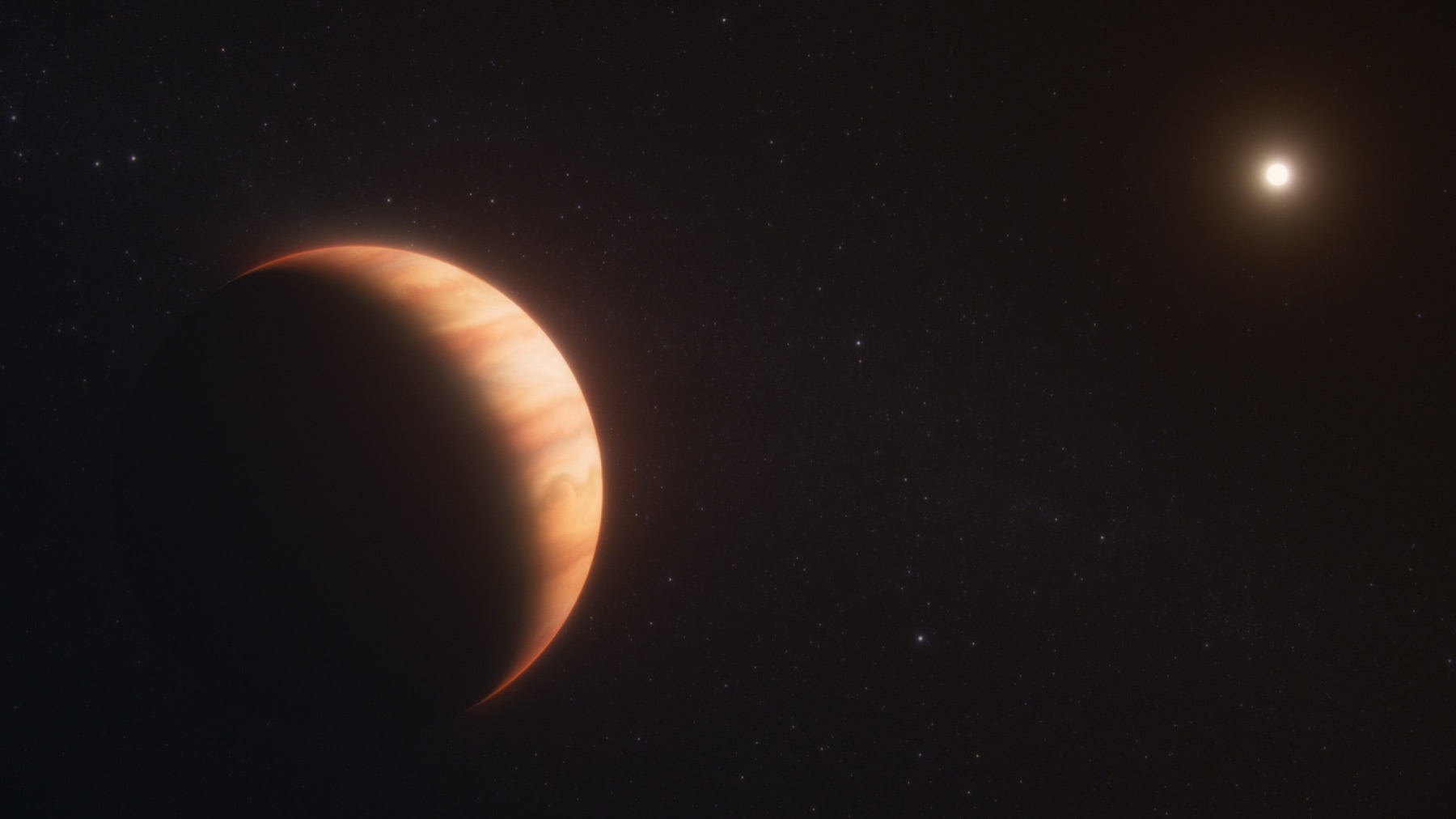
A white dwarf is the hot, dense core left when a star like the Sun dies: roughly half the Sun’s mass or more, packed into a ball about the size of Earth. It no longer generates energy by fusion and simply cools over billions of years. Over 97% of the stars in our galaxy, including the Sun, will end their lives as white dwarfs, which makes them the most common stellar corpse in the universe.
White dwarfs are one of three possible endings for a star, and the quietest. For the full life cycle, see our stars guide.
How do white dwarfs form?
White dwarfs form from stars with less than about 8 times the Sun’s mass, according to NASA. When such a star exhausts the hydrogen in its core, it swells into a red giant and fuses helium into carbon and oxygen. It is not massive enough to fuse those further. Eventually it puffs its outer layers into space, often as a glowing planetary nebula, and the bare core remains: a white dwarf, mostly carbon and oxygen, initially very hot.
That is the future of the Sun. NASA says that in about 10 billion years, after its time as a red giant, the Sun will become a white dwarf. Our explainer when will the Sun die follows its path in detail.
According to a 2001 review by Fontaine, Brassard and Bergeron, more than 97% of the stars in the Milky Way will eventually become white dwarfs. Only the rare stars above about 8 solar masses end as neutron stars or black holes.
What holds a white dwarf up?
A white dwarf has no fusion to support it against gravity. Instead it is held up by electron degeneracy pressure: a quantum rule says no two electrons can occupy the same state, so packed electrons resist further squeezing no matter how cold the star becomes.
That support has a limit. In 1931 Subrahmanyan Chandrasekhar showed that above a maximum mass, electron pressure fails (the Chandrasekhar limit). The value is about 1.4 solar masses. He shared the 1983 Nobel Prize in Physics, cited for his studies of the physical processes important to the structure and evolution of stars.
White dwarf facts and figures
| Property | Typical value | Source |
|---|---|---|
| Mass | Average about 0.59 solar masses (most common type) | Kepler et al. 2007, Sloan survey sample |
| Maximum mass | About 1.4 solar masses (Chandrasekhar limit) | Chandrasekhar 1931; NASA |
| Size | Slightly bigger than Earth | NASA |
| Density | About 109 kg per cubic meter, 200,000 times Earth’s | NASA |
| Teaspoon of material | Weighs more than a pickup truck | NASA |
| Progenitor stars | Less than about 8 solar masses | NASA |
| Share of stars ending this way | Over 97% in the Milky Way | Fontaine et al. 2001 |
Sirius B: the white dwarf next door
The most famous white dwarf is Sirius B, the faint companion of Sirius, the brightest star in the night sky. Its story shows how white dwarfs were discovered. In 1844 Friedrich Bessel noticed that Sirius wobbled back and forth as if orbiting an unseen object. The companion was first glimpsed in the early 1860s by the optician and telescope maker Alvan Clark (NASA sources give 1862 or 1863).
It turned out to be bizarre: a star with about as much mass as the Sun but far too faint for its temperature, meaning it had to be tiny. Hubble measurements published in 2005 (Barstow et al.) gave a mass of about 98% of the Sun’s, a diameter of about 7,500 miles (slightly smaller than Earth), a surface gravity 350,000 times Earth’s and a surface temperature of about 25,200 kelvins. Later orbital work refined the mass to 1.02 solar masses (Bond et al. 2017).
Do white dwarfs ever explode?
Usually not, but in binary systems they can. If a white dwarf pulls gas from a companion star, or merges with another white dwarf, and is pushed over the Chandrasekhar limit, it ignites in a runaway thermonuclear explosion, a Type Ia supernova, leaving nothing behind (Chandra X-ray Center).
Type Ia supernovae are so consistent in brightness that they serve as cosmic distance markers. In 1998 two teams used them to discover that the expansion of the universe is accelerating (the accelerating universe), the first evidence for dark energy.
How white dwarfs cool, and what comes after
A white dwarf starts extremely hot and spends the rest of time cooling, like an ember. In 2019 Tremblay and colleagues used Gaia data on white dwarfs within 100 parsecs of the Sun to find a pile-up in their cooling sequence (Nature). The cause: as the carbon-oxygen cores crystallize into solid, they release latent heat, which delays cooling by about a billion years. Many old white dwarfs are, in effect, cooling crystals.
Eventually a white dwarf would cool into a cold, dark black dwarf. None exists yet: NASA notes that white dwarfs cool so slowly that the universe is probably not old enough for many, if any, to have become black dwarfs. That is one reason the universe can be called young (is the universe young?). White dwarfs dominate the far future of the cosmos, in the Degenerate Era, after the last stars have burned out.
White dwarfs are also places where planets survive. In 2026 JWST showed how the giant planet WD 1856 b outlived its star’s red giant phase (WD 1856 b), and Hubble spectra of the white dwarf HS 0209+0832 hinted at a “second-generation” planet built from the dying star’s debris (a candidate second-generation planet).
Questions people ask
What is a white dwarf?
A white dwarf is the dense, hot core left behind when a low- or medium-mass star, like the Sun, runs out of fuel and sheds its outer layers. It has roughly half to one solar mass packed into a ball about the size of Earth. It no longer makes energy by fusion and simply cools for billions of years.
Will the Sun become a white dwarf?
Yes. NASA says that in about 10 billion years, after its time as a red giant, the Sun will become a white dwarf. It is far too light to explode as a supernova or to become a neutron star or black hole. Its exposed core will glow white-hot at first, then slowly cool and fade.
How dense is a white dwarf?
Extremely. NASA gives a density of about a billion kilograms per cubic meter, roughly 200,000 times the density of Earth, and says a teaspoon of white dwarf material would weigh more than a pickup truck. The matter is held up by electrons packed as tightly as quantum physics allows.
What is a black dwarf?
A black dwarf is what a white dwarf would become after cooling so much that it no longer gives off visible light or significant heat. None is thought to exist yet: white dwarfs cool so slowly that, according to NASA, the universe is probably not old enough for many, if any, to have become black dwarfs.
What is Sirius B?
Sirius B is the white dwarf companion of Sirius, the brightest star in the night sky, about 8.6 light-years away. Hubble measurements published in 2005 gave it about 98% of the Sun's mass in a body about 7,500 miles across, slightly smaller than Earth, with a surface temperature of about 25,200 kelvins.
Can a white dwarf explode?
Yes, if it gains too much mass. A white dwarf that pulls matter from a companion star, or merges with another white dwarf, can be pushed past the Chandrasekhar limit of about 1.4 solar masses. It then ignites in a runaway thermonuclear explosion, a Type Ia supernova, that leaves nothing behind.