Beta Pictoris d Is the Faintest Exoplanet Ever Imaged From the Ground
Spotted with ESO's VLT and found in 11 years of archives, Beta Pictoris d is 100 times fainter than its sibling b and weighs about 2.4 Jupiters.
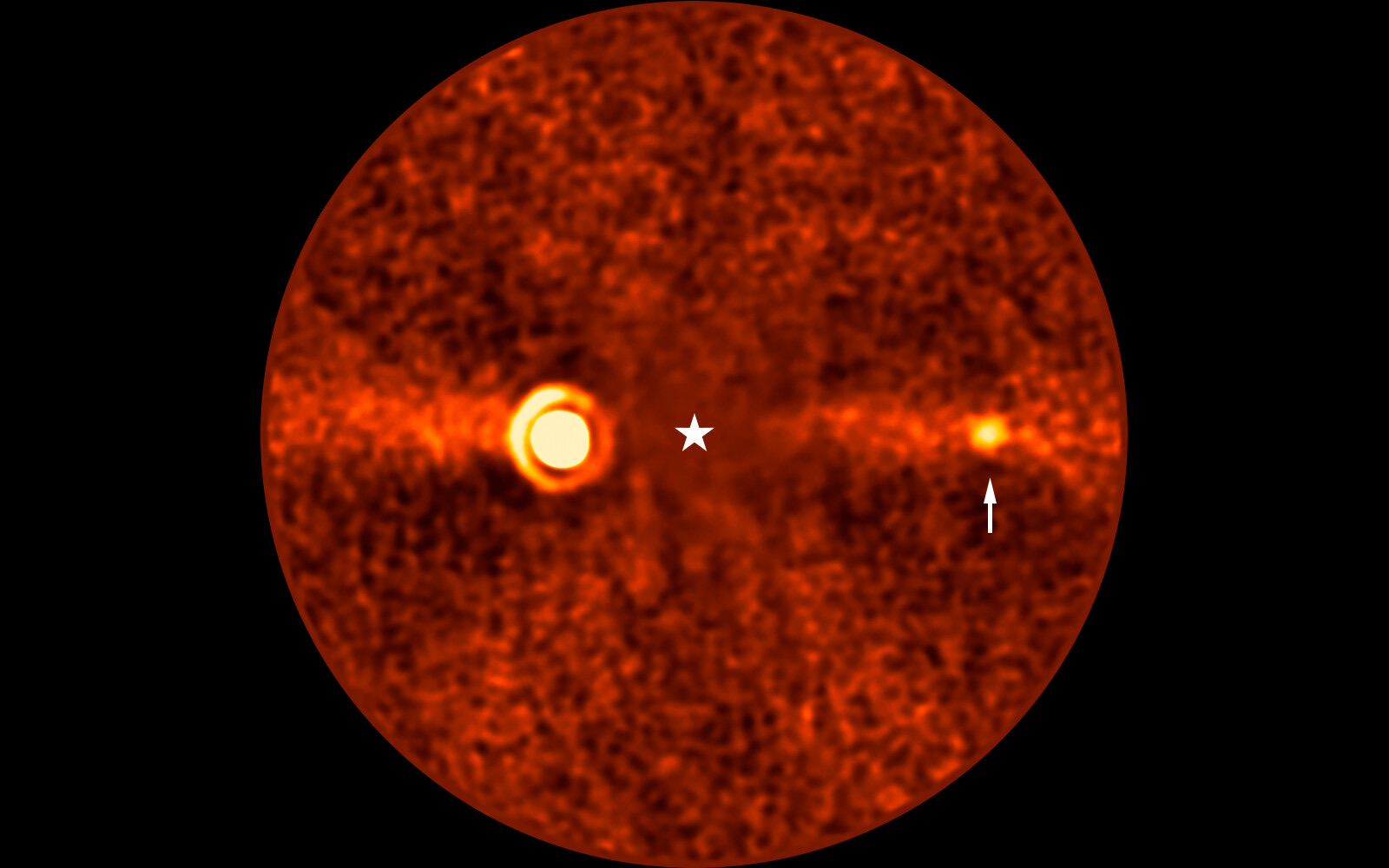
Beta Pictoris d, a newly found third planet around the young star Beta Pictoris, is the faintest exoplanet ever imaged directly from Earth. It is about 100 times fainter than its sibling Beta Pictoris b. The discovery was published in The Astrophysical Journal Letters, and ESO announced it on July 15, 2026. The star lies 63 light-years from Earth.
The first clear detection came from the ERIS instrument on ESO’s Very Large Telescope. Once the team knew where to look, they found the planet in archival images going back about 11 years. An independent team led by Aidan Gibbs found the same planet with the James Webb Space Telescope, and both results appear in the same journal. Two instruments seeing the same object independently is strong confirmation.
Beta Pictoris d has about 2.4 times the mass of Jupiter, far lighter than planets b and c, which have roughly 10 Jupiter masses each. It also orbits much farther out. Wider orbits mean colder planets, and colder, lighter planets give off less light, which is why it is so hard to see next to its star.
Direct imaging means capturing the planet’s own light instead of inferring it from its effect on the star. The technique took a major step in 2008 with the HR 8799 system, and now reaches fainter, lighter worlds from the ground. Imaging a cold, low-mass giant planet pushes the method toward the kinds of planets future extremely large telescopes will study in detail. More in our exoplanets guide.
What to watch next: follow-up imaging to trace the planet’s orbit and measure its atmosphere.
Primary source
This summary is based on ESO and the peer-reviewed paper. Read the original for full details, data and caveats.
This week in papers
The week's most important results, one line each, every week.