2008
Marois et al., Science, 322, 1348-1352, 2008
HR 8799 (2008): The First Photo of a Multi-Planet System
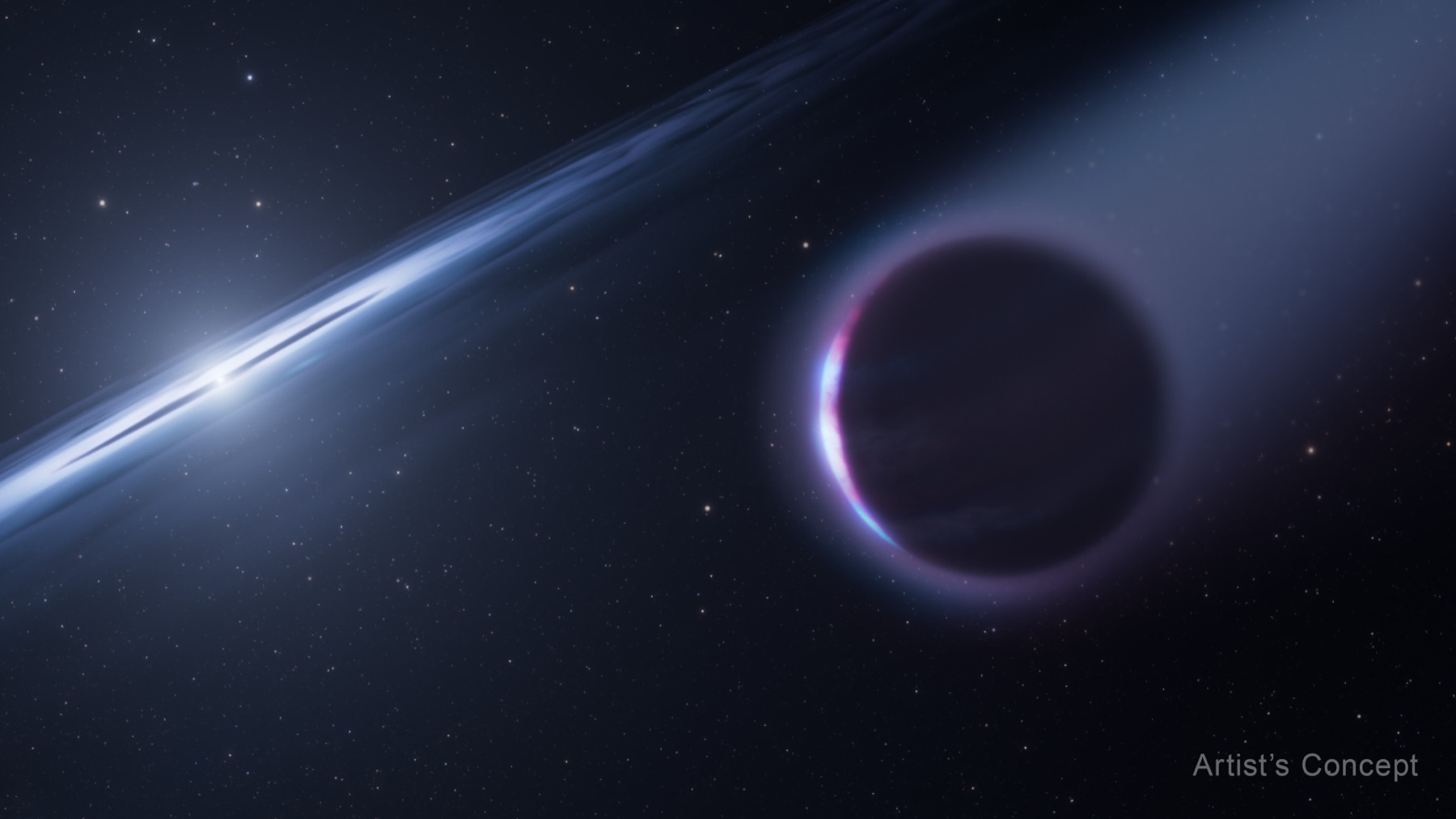
Photographed in 2008 three giant planets orbiting the young star HR 8799. Marois and colleagues used Keck and Gemini to image a whole planetary system.
Christian Marois and colleagues took the first direct pictures of a multi-planet system in 2008, photographing three giant planets around the young star HR 8799 with the Keck and Gemini telescopes. Instead of inferring planets from their effects on the star, they captured the planets’ own light.
Why was it so hard to photograph a planet?
Until 2008, exoplanets were known mostly from indirect signals. Methods like the one behind the 1995 discovery of 51 Pegasi b detect a planet’s pull on its star, not the planet. Taking an actual image is much harder for two reasons the paper spells out: the planet sits a tiny angle away from its star on the sky, and the star outshines it enormously. It is like spotting a firefly beside a searchlight.
What the paper found
- Three planets in one frame. Images revealed three companions to HR 8799 at projected separations of 24, 38 and 68 AU (1 AU is the Earth-Sun distance).
- Real orbits, seen moving. Images taken at several epochs, meaning different dates, showed all three planets moving counterclockwise around the star. That ruled out unrelated background stars.
- Planets, not failed stars. From their faint glow and the system’s young age, the team estimated masses between 5 and 13 times that of Jupiter.
- A familiar layout, scaled up. The authors describe the system as a larger version of the outer Solar System, with giant planets on wide orbits.
How they did it
The team used adaptive optics, which corrects for the blurring of Earth’s atmosphere, on the 10-meter W. M. Keck Observatory telescopes and the 8.1-meter Gemini North telescope, both on Maunakea, Hawaii. They observed in near-infrared light, 1.1 to 4.2 micrometers, where the young planets still glow with heat left over from their formation. The star is only about 60 million years old.
The key trick was angular differential imaging. As the night passes, the sky slowly rotates in the camera while the telescope’s own optical flaws stay fixed. Real planets turn with the sky; glare artifacts do not, so they can be subtracted away. Planets b and c first appeared in Gemini data from October 2007, planet d in Keck data from 2008, and b and c were also recovered in older Keck images from 2004.
The masses come from models: a young planet of known age and brightness should have a predictable mass.
Why it mattered
This was the first image of a multi-planet system around another star, and it proved that direct imaging works. Light collected straight from a planet can be split into a spectrum and analyzed, revealing its temperature and chemistry without waiting for it to pass in front of its star. That complements transit methods such as the one behind Webb’s detection of carbon dioxide on WASP-39b, and it is the technique future telescopes plan to use to look for Earth-like worlds.
What we know now
A fourth planet in the HR 8799 system was reported in 2010. Imaging has since pushed toward fainter, colder planets. The Gemini Planet Imager can directly image planets one-millionth as bright as their host star. In July 2026, ESO’s Very Large Telescope made Beta Pictoris d the faintest exoplanet ever imaged from the ground, at about 2.4 Jupiter masses, and an independent team found it with JWST.
Who wrote it
The study was led by Christian Marois of the NRC Herzberg Institute of Astrophysics in Victoria, Canada, with Bruce Macintosh of Lawrence Livermore National Laboratory, Travis Barman of Lowell Observatory and colleagues in the United States, Canada and the United Kingdom.
Read the original
Marois, C., Macintosh, B., Barman, T., et al. (2008). “Direct Imaging of Multiple Planets Orbiting the Star HR 8799.” Science 322, 1348-1352. doi:10.1126/science.1166585
Free to read: arXiv preprint.
This week in papers
Five new results in one line each, plus one landmark like this one. Weekly.
Keep reading
Borucki et al., Science, 327, 977-980, 2010
Kepler's First Results: Hunting Earth-Size Planets
Found in 2010 Kepler's first five planets after watching 156,000 stars for six weeks. William Borucki's NASA mission went on to confirm 2,681 planets.
Charbonneau et al., The Astrophysical Journal Letters, 529, L45-L48, 2000
First Transiting Exoplanet: HD 209458 b Crosses Its Star
Detected the first planet crossing in front of its star in 2000. Charbonneau and colleagues measured HD 209458 b's size, the start of the transit method.
Anglada-Escudé et al., Nature, 536, 437-440, 2016
Proxima b: A Temperate Planet Around the Nearest Star
Found in 2016 Proxima b, a planet of at least 1.3 Earth masses orbiting the nearest star. Anglada-Escudé's team caught the star wobbling every 11.2 days.
Topic guide
Exoplanets
Recent news in exoplanets