2019
Landmark paper
Event Horizon Telescope Collaboration, The Astrophysical Journal Letters, 875, L1, 2019
First Image of a Black Hole (2019): The M87* Shadow Explained
Captured in 2019 the first image of a black hole: a ring of light around the shadow of M87*, 6.5 billion Suns. The Event Horizon Telescope's paper.
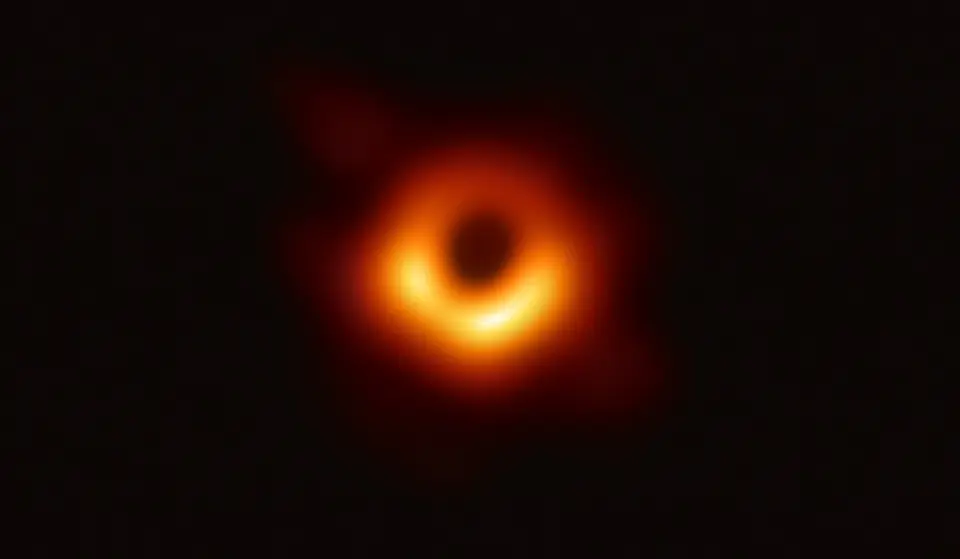
The first image of a black hole was released on April 10, 2019, by the Event Horizon Telescope collaboration. It shows a lopsided ring of glowing gas around a dark center: the shadow of the supermassive black hole in the galaxy M87, about 55 million light-years away and some 6.5 billion times the mass of the Sun.
The question before the paper
For a century, black holes were known through their effects: orbiting stars, X-rays from hot gas, and from 2015 the gravitational waves of merging pairs. General relativity predicted that a black hole surrounded by glowing matter would cast a “shadow”, a dark region outlined by light bent around the event horizon. But even the biggest black holes look extraordinarily small from Earth. Could any telescope see one?
What the paper found
- A ring with a dark center. The image shows an asymmetric bright ring of emission 42 ± 3 microarcseconds across, around a central brightness depression with a contrast of about 10 to 1.
- The size general relativity predicts. The ring is consistent with the shadow of a spinning, Kerr black hole of about 6.5 billion solar masses.
- Stable and robust. The ring held its size across four observing days and appeared with different imaging methods, ruling out an artifact of one technique.
How the black hole image was captured
No single dish is big enough. The Event Horizon Telescope links radio telescopes around the world into one Earth-sized instrument, a technique called very-long-baseline interferometry. Eight telescopes observed M87 together in April 2017, at a wavelength of 1.3 millimeters. Each recorded the incoming radio waves with precise timing, and the recordings were later combined by computer to reconstruct the image. The array’s theoretical resolution is about 25 microarcseconds.
The ring’s 42 microarcseconds is about the angular size of an orange on the surface of the Moon, seen from Earth.
Why it mattered
This was the first image of a black hole’s shadow, turning a century-old prediction into a photograph. It opened tests of gravity right at the event horizon, and of how black holes launch the jets of particles that stream from galaxies like M87. The results appeared as a series of six papers in The Astrophysical Journal Letters; this is paper I, the overview.
What we know now
In March 2021 the EHT released an image of M87* in polarized light, tracing magnetic fields near the event horizon. On May 12, 2022, it published the first image of Sagittarius A*, the black hole at the center of our own galaxy, more than a thousand times less massive. The two images together show general relativity at work across a huge range of black hole sizes. See our black holes guide.
Who wrote it
The paper is signed by the Event Horizon Telescope Collaboration, with individual authors starting with Kazunori Akiyama and Antxon Alberdi. It has about 3,900 citations in Semantic Scholar as of October 2026.
Read the original
Event Horizon Telescope Collaboration, Akiyama, K., Alberdi, A., et al. (2019). “First M87 Event Horizon Telescope Results. I. The Shadow of the Supermassive Black Hole.” The Astrophysical Journal Letters. doi:10.3847/2041-8213/ab0ec7. Free on arXiv: 1906.11238. ESO’s press release has the image in full resolution.
Questions people ask
When was the first image of a black hole taken?
The data were collected in April 2017 by the Event Horizon Telescope, a network of eight radio telescopes observing together. Processing took two years, and the image of the black hole in galaxy M87 was released on April 10, 2019, in coordinated press conferences around the world.
Is the black hole image a real photograph?
It is a real image, but not a snapshot from one camera. The Event Horizon Telescope combined radio signals recorded by eight telescopes across the planet into a single image. The colors are added: they show the brightness of radio emission at 1.3 millimeters, which the eye cannot see.
How big is the M87 black hole?
The black hole in M87 has a mass of about 6.5 billion Suns and lies about 55 million light-years away. Its glowing ring spans 42 microarcseconds on the sky, a tiny angle that took an Earth-sized network of radio telescopes to resolve.
This week in papers
Five new results in one line each, plus one landmark like this one. Weekly.
Keep reading
Event Horizon Telescope Collaboration, The Astrophysical Journal Letters, 930, L12, 2022
Sagittarius A* Image: The Milky Way's Black Hole, Seen
Imaged in 2022 the shadow of Sagittarius A*, the 4-million-Sun black hole at the Milky Way's center. The Event Horizon Telescope's first Sgr A* paper.
Maiolino et al., Nature, 627, 59-63, 2024
GN-z11's Black Hole: Feeding Fast in the Early Universe
Found with JWST a 1.6-million-Sun black hole feeding at five times the usual limit in GN-z11, at redshift 10.6. Roberto Maiolino's team, Nature 2024.
Ghez et al., The Astrophysical Journal, 689, 1044-1062, 2008
Andrea Ghez: Weighing the Milky Way's Black Hole With Stars
Weighed the Milky Way's central black hole at about 4 million Suns by tracking the star S0-2 for 12 years with Keck. Andrea Ghez's team, 2008.
Topic guide
Black holes
Recent news in black holes