2024
Maiolino et al., Nature, 627, 59-63, 2024
GN-z11's Black Hole (2024): Feeding Fast in the Early Universe
Found with JWST a 1.6-million-Sun black hole feeding at five times the usual limit in GN-z11, at redshift 10.6. Roberto Maiolino's team, Nature 2024.
The black hole in GN-z11, reported in Nature in January 2024 by Roberto Maiolino and colleagues, is one of the earliest known. Using the James Webb Space Telescope, the team found signs of a black hole of about 1.6 million solar masses in a galaxy at redshift 10.6, gobbling matter about five times faster than the standard limit.
The question before the paper
Quasars, powered by supermassive black holes, were known to exist when the universe was young. That poses a timing problem. Black holes grow by swallowing gas, and there is a standard limit to how fast they can do it, the Eddington limit, set by the point where the radiation from infalling gas pushes back as hard as gravity pulls. How did black holes get so big so fast? Catching one in the act, early and still small, would help.
What the paper found
- An active black hole in GN-z11. The spectrum of GN-z11, an exceptionally luminous galaxy at redshift 10.6, shows emission lines typical of active galactic nuclei, including ionized neon ([Ne IV]) and dense gas from a “broad-line region” close to a black hole.
- A powerful outflow. A blueshifted absorption feature traces gas streaming outward at 800 to 1,000 km/s, probably driven by the black hole.
- Small but vigorous. The black hole’s mass is about 106.2, roughly 1.6 million, solar masses, and it is accreting at about five times the Eddington rate.
- Two possible origins. The properties fit either “heavy seeds”, black holes born large, or lighter seeds that grew through bursts of super-Eddington feeding.
How they did it
The team analyzed a spectrum taken with NIRSpec, the near-infrared spectrograph on the James Webb Space Telescope. At redshift 10.6, light that left the galaxy in the ultraviolet and visible arrives stretched into the infrared, where Webb is most sensitive. Specific emission lines, with their widths and ratios, act as fingerprints: some can only be produced by the intense radiation near a feeding black hole, and the width of the broad lines, set by the speed of orbiting gas, gives the black hole’s mass.
Why it mattered
GN-z11 hosts one of the earliest black holes known, and its rapid feeding helps explain how supermassive black holes could appear so soon after the Big Bang. JWST is finding many such early active nuclei, reshaping theories of how black holes began. The paper has about 240 citations in Semantic Scholar as of October 2026.
What we know now
Webb has since found a large population of compact, red early objects, the “little red dots”, now often interpreted as young black holes wrapped in dense gas; a January 2026 Nature study argued their black holes are about 100 times less massive than first estimated, though alternatives are still being published. See our little red dots explainer. At slightly later times, Euclid and Keck reported in 2026 12 new quasars beyond redshift 7.
Who wrote it
Roberto Maiolino led the study, with Jan Scholtz, Joris Witstok and colleagues. The preprint was posted to arXiv in May 2023, months before the peer-reviewed version appeared in Nature.
Read the original
Maiolino, R., Scholtz, J., Witstok, J., et al. (2024). “A small and vigorous black hole in the early Universe.” Nature. doi:10.1038/s41586-024-07052-5. Published online January 17, 2024. Free on arXiv: 2305.12492.
This week in papers
Five new results in one line each, plus one landmark like this one. Weekly.
Keep reading
Event Horizon Telescope Collaboration, The Astrophysical Journal Letters, 930, L12, 2022
Sagittarius A* Image: The Milky Way's Black Hole, Seen
Imaged in 2022 the shadow of Sagittarius A*, the 4-million-Sun black hole at the Milky Way's center. The Event Horizon Telescope's first Sgr A* paper.
Event Horizon Telescope Collaboration, The Astrophysical Journal Letters, 875, L1, 2019
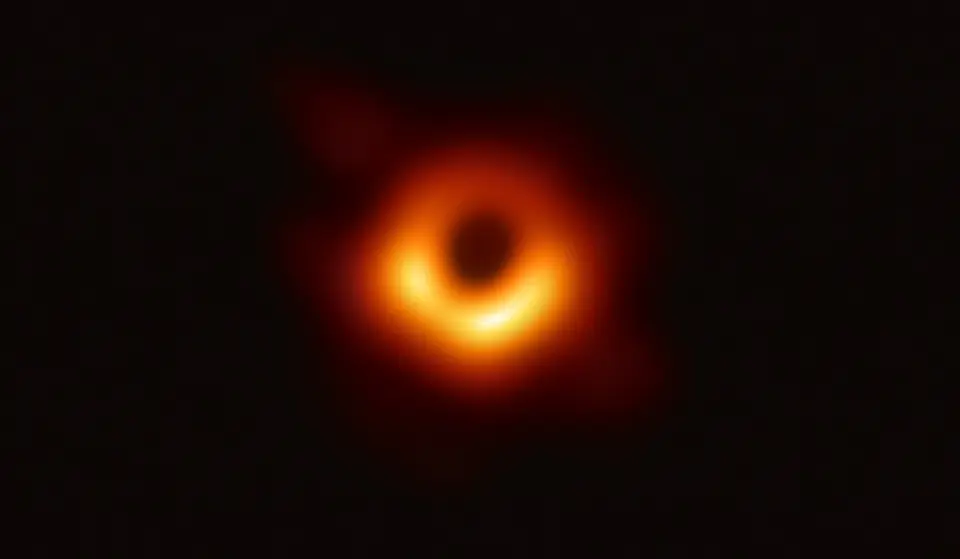
First Image of a Black Hole: The M87* Shadow Explained
Captured in 2019 the first image of a black hole: a ring of light around the shadow of M87*, 6.5 billion Suns. The Event Horizon Telescope's paper.
Ghez et al., The Astrophysical Journal, 689, 1044-1062, 2008
Andrea Ghez: Weighing the Milky Way's Black Hole With Stars
Weighed the Milky Way's central black hole at about 4 million Suns by tracking the star S0-2 for 12 years with Keck. Andrea Ghez's team, 2008.
Topic guide
Black holes
Recent news in black holes