2022
Event Horizon Telescope Collaboration, The Astrophysical Journal Letters, 930, L12, 2022
Sagittarius A* Image (2022): The Milky Way's Black Hole, Seen
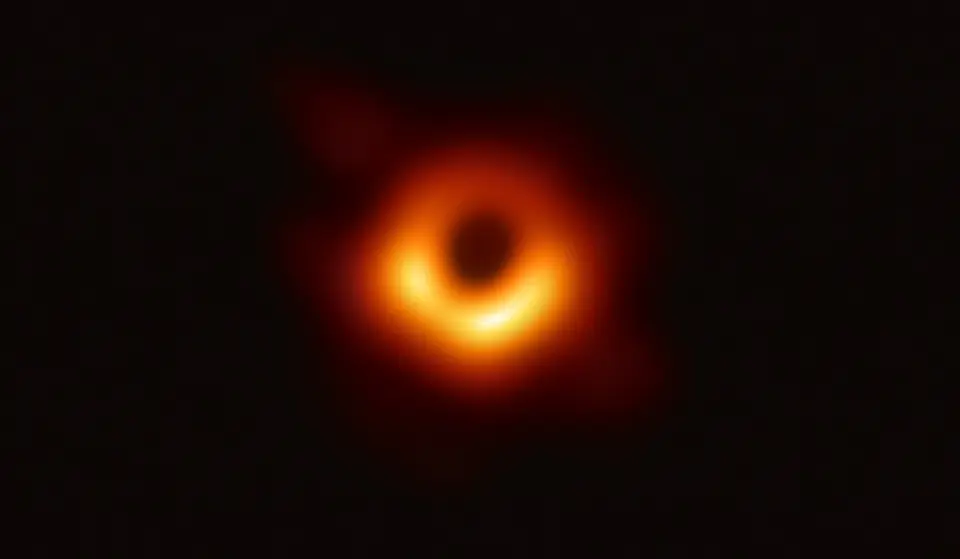
Imaged in 2022 the shadow of Sagittarius A*, the 4-million-Sun black hole at the Milky Way's center. The Event Horizon Telescope's first Sgr A* paper.
The first image of Sagittarius A*, the supermassive black hole at the center of our galaxy, was announced on May 12, 2022, by the Event Horizon Telescope collaboration. It shows a bright, thick ring about 52 microarcseconds across around a dark shadow, consistent with a black hole of about 4 million solar masses.
The question before the paper
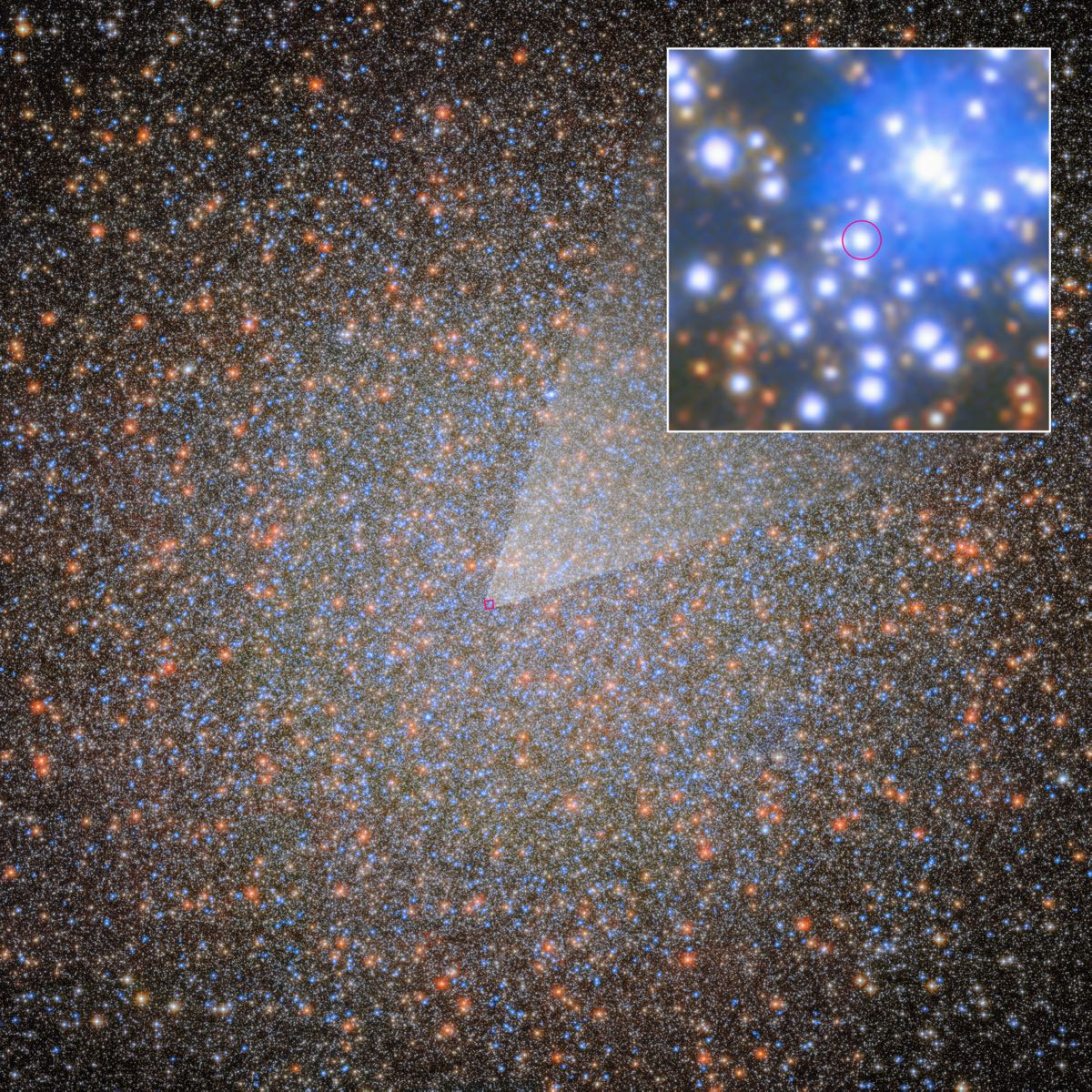
Stars racing around the galactic center had already shown that something of about 4 million solar masses sits in a tiny region there, the result recognized by the 2020 Nobel Prize for Andrea Ghez’s orbit measurements and Reinhard Genzel’s. In 2019 the Event Horizon Telescope had imaged the black hole in M87. Could the same technique see the shadow of our own black hole, and would its size match the mass weighed by the stars?
What the paper found
- A ring around a shadow. The image is dominated by a bright, thick ring with a diameter of 51.8 ± 2.3 microarcseconds.
- The right mass. The ring is consistent with a spinning, Kerr black hole of about 4 million solar masses, matching the mass inferred from stellar orbits.
- Probably not seen edge-on. Comparisons with models disfavor scenarios in which we view the black hole at high inclination.
How they did it
The observations were made in 2017 with eight telescopes of the Event Horizon Telescope, a planet-wide network of radio dishes linked by very-long-baseline interferometry at a wavelength of 1.3 millimeters. The same 2017 campaign produced the M87 image.
Sagittarius A* was much harder. It is over a thousand times less massive than M87*, so gas orbits it far faster, and its appearance varies within an hour. The M87 ring barely changed over days. Imaging a target that changes during a single night’s observation is like photographing a toddler instead of a statue, and it made the analysis much harder than for M87.
Why it mattered
Seeing the shadow of our own galaxy’s black hole confirmed, by a completely independent method, the mass measured from orbiting stars. Comparing it with M87*, a black hole more than a thousand times more massive, shows that general relativity governs both: the shadow scales with mass just as the theory predicts.
What we know now
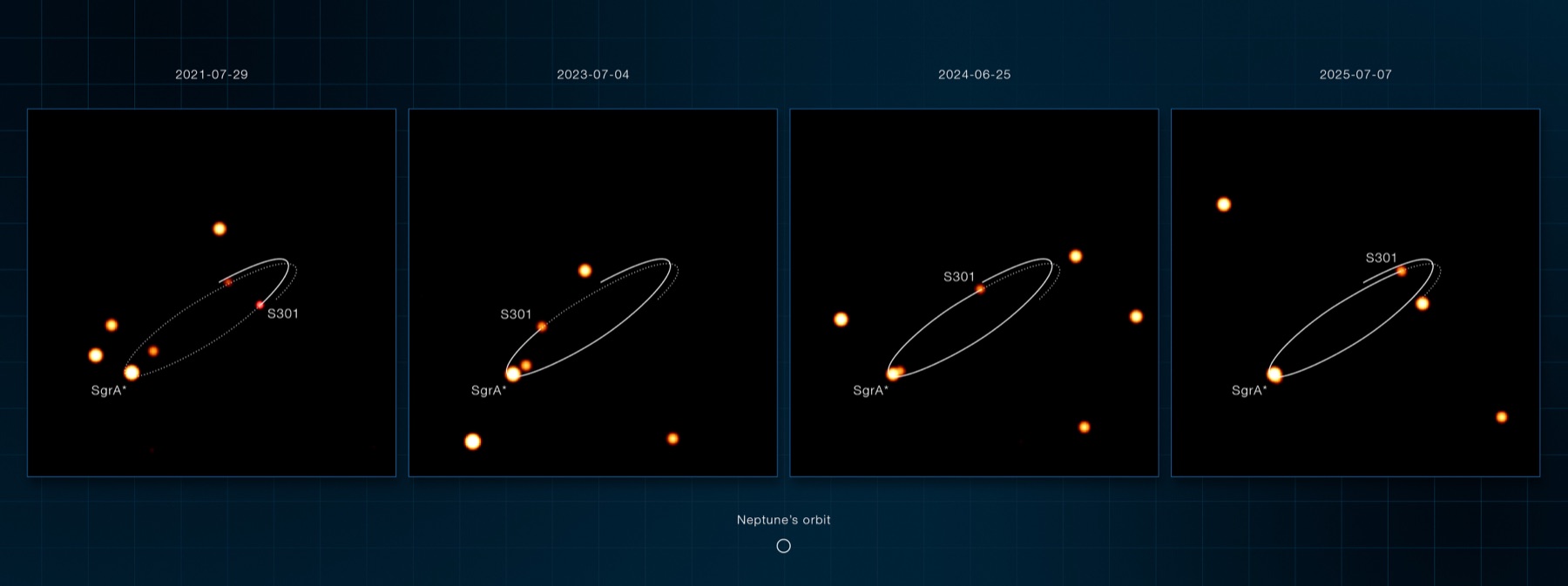
In March 2024 the EHT released an image of Sagittarius A* in polarized light, the same kind of view it had made of M87* in 2021. The Very Large Telescope keeps tracking stars ever closer to the black hole: in 2026 ESO reported S301, the fastest known star in the Milky Way, which may let astronomers measure the black hole’s spin within about 10 years. See our black holes guide.
Who wrote it
The paper is signed by the Event Horizon Telescope Collaboration, with individual authors starting with Kazunori Akiyama and Antxon Alberdi. It has about 1,700 citations in Semantic Scholar as of October 2026.
Read the original
Event Horizon Telescope Collaboration, Akiyama, K., Alberdi, A., et al. (2022). “First Sagittarius A* Event Horizon Telescope Results. I. The Shadow of the Supermassive Black Hole in the Center of the Milky Way.” The Astrophysical Journal Letters. doi:10.3847/2041-8213/ac6674. Free on arXiv: 2311.08680.
This week in papers
Five new results in one line each, plus one landmark like this one. Weekly.
Keep reading
Maiolino et al., Nature, 627, 59-63, 2024
GN-z11's Black Hole: Feeding Fast in the Early Universe
Found with JWST a 1.6-million-Sun black hole feeding at five times the usual limit in GN-z11, at redshift 10.6. Roberto Maiolino's team, Nature 2024.
Event Horizon Telescope Collaboration, The Astrophysical Journal Letters, 875, L1, 2019
First Image of a Black Hole: The M87* Shadow Explained
Captured in 2019 the first image of a black hole: a ring of light around the shadow of M87*, 6.5 billion Suns. The Event Horizon Telescope's paper.
Ghez et al., The Astrophysical Journal, 689, 1044-1062, 2008
Andrea Ghez: Weighing the Milky Way's Black Hole With Stars
Weighed the Milky Way's central black hole at about 4 million Suns by tracking the star S0-2 for 12 years with Keck. Andrea Ghez's team, 2008.
Topic guide
Black holes
Recent news in black holes