Little red dots
Little red dots are compact red objects JWST sees in the early universe. The leading 2026 explanation: young black holes wrapped in dense cocoons of gas.
By The Orbital Record editorial teamPublished Last reviewed
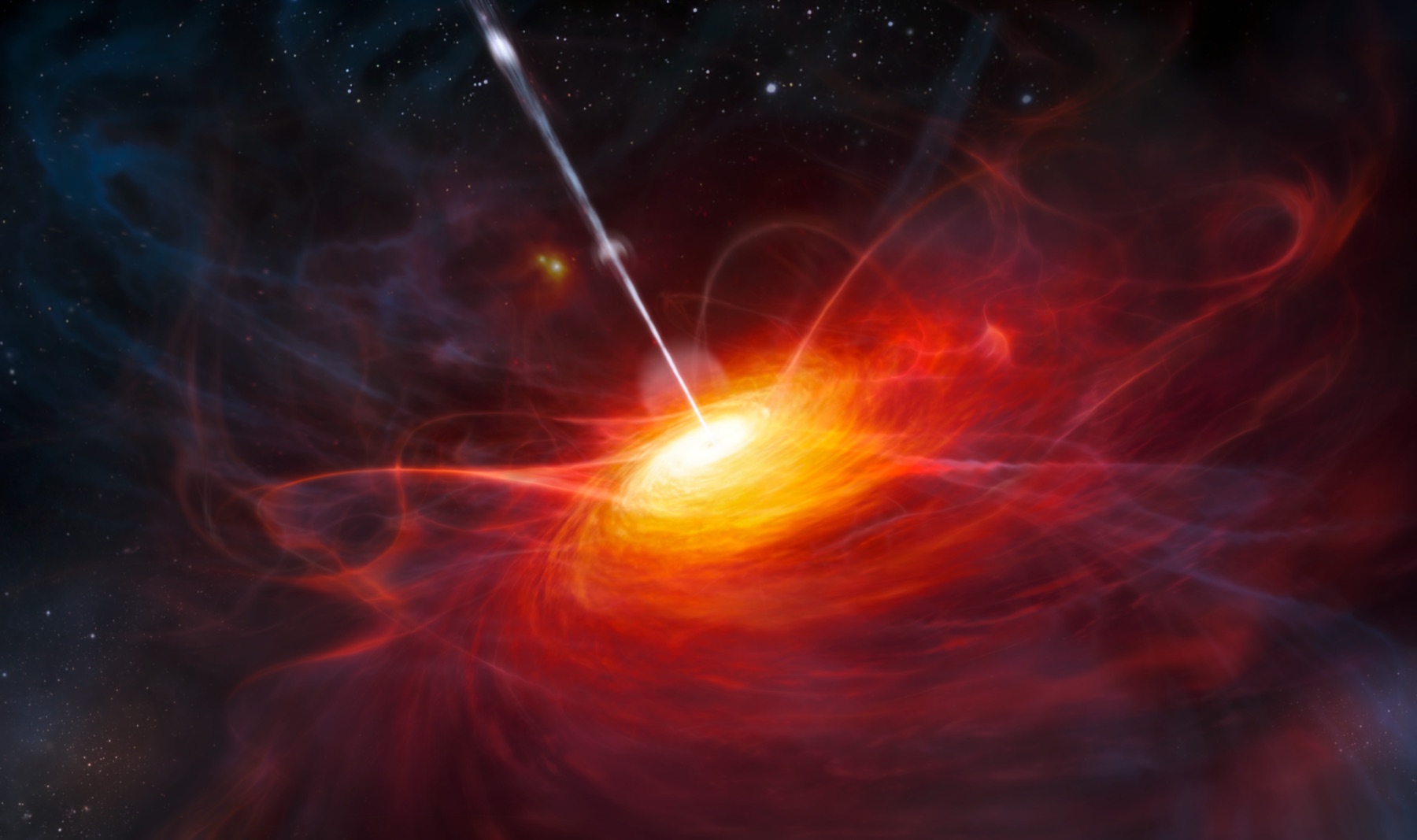
Little red dots are compact, unusually red objects that the James Webb Space Telescope finds in large numbers in the early universe. The leading explanation, published in Nature in January 2026, is that they are young supermassive black holes buried in dense cocoons of ionized gas, about 100 times lighter than first estimated.
They are one of JWST’s most surprising discoveries and a live research topic, so this explainer separates what is measured from what is still argued. For the bigger picture of how black holes form and grow, see our black holes guide.
What are little red dots?
Little red dots are point-like sources, too small for JWST to resolve, that appear red in its infrared cameras and show a characteristic “V-shaped” spectrum: blue in the ultraviolet, red in the optical, with the turn near the Balmer limit of hydrogen at 365 nanometers. Many show broad hydrogen emission lines, the classic sign of gas swirling near a black hole.
Key facts, as of October 2026:
- When: most are seen roughly 600 million to 1.5 billion years after the Big Bang.
- How many: a 2024 survey by Dale Kocevski and colleagues catalogued 341 across the main JWST deep fields, at redshifts from about 2 to 11.
- How common: about ten times more numerous than ordinary quasars and X-ray-selected active black holes at the same epoch.
- When they fade: their numbers fall sharply after a redshift of about 4.5, so they are rare in the later universe.
How were little red dots discovered?
JWST’s first deep images in 2022 and 2023 were full of small red specks. In 2023, Ivo Labbé and colleagues reported six of them as candidate galaxies with ten billion or more solar masses of stars only 500 to 700 million years after the Big Bang (massive early galaxies). If true, the early universe had formed stars far faster than the standard model allowed.
Spectroscopy changed the story. Follow-up showed that at least one of the Labbé candidates is a dust-reddened active black hole, not a giant galaxy. In a paper published in The Astrophysical Journal in 2024, Jorryt Matthee and colleagues found 20 such objects with broad hydrogen lines in two JWST surveys, named the population “little red dots”, and showed they were far more common than expected from quasars.
The puzzle
For two years, little red dots refused to fit any single explanation. The table summarizes the main interpretations:
| Interpretation | What it says | What supports it | What does not fit |
|---|---|---|---|
| Massive early galaxies | Red light from huge numbers of old stars | Red colors, early times | Would need impossibly fast star formation; broad lines need a black hole |
| Dusty active black holes | Normal growing black holes hidden by dust | Broad lines | Very weak X-rays; many look largely dust-free |
| Black holes in dense gas cocoons | Young black holes wrapped in thick ionized gas | Line shapes, Balmer breaks, weak X-rays | Still being tested; masses depend on the model |
| Extremely dense star clusters | Compact stellar systems, no dominant black hole | Some spectral features | Hard to produce the observed ionizing power |
The black holes inferred from the broad lines looked too big for their small host galaxies, sometimes by large factors. Most also turned out to be extremely faint in X-rays and radio, which ordinary feeding black holes are not.
The 2026 answer: young black holes in dense cocoons
In January 2026 Vadim Rusakov and colleagues published “Little red dots as young supermassive black holes in dense ionized cocoons” in Nature (volume 649, pages 574 to 579). They analyzed the highest-quality JWST spectra of 12 little red dots, plus a combined spectrum of 18 more, at redshifts from 2.3 to 6.8.
Their key finding concerns the shape of the broad hydrogen lines. The lines have exponential wings, the signature of light bouncing off free electrons in dense ionized gas, rather than the profile expected from gas orbiting fast. In other words, the lines are broad because they are scattered, not because the gas is moving at enormous speeds. Underneath is a narrow core.
That changes the black hole masses. Estimates based on line width had given about 1 million to 100 million solar masses. The narrow cores imply about 100,000 to 10 million, roughly two orders of magnitude less, which makes them the lowest-mass black holes known at such early times. At those masses they sit on the same relation between black hole and host galaxy that holds today, so they no longer look oversized.
The picture: a young black hole, growing at or near its maximum rate, surrounded by a thick, roughly spherical shell of dense gas, with enough electrons along the line of sight to scatter most of the light. The cocoon would also explain the weak X-rays and the red color. The authors suggest we may be watching the main growth phase of supermassive black holes.
The interpretation is the leading one, not a settled one. It rests on a modest sample, and alternative explanations are still being published. A companion study posted to arXiv in January 2026, not yet peer reviewed, models the cocoon spectra in more detail.
Black hole stars
A related idea makes the cocoon even more extreme. In March 2025 Rohan Naidu, Jorryt Matthee, Harley Katz and colleagues posted a preprint on an object they named MoM-BH*-1, seen 660 million years after the Big Bang. Its spectrum shows the strongest Balmer break ever recorded and hydrogen absorption lines, features normally associated with stars. They proposed a “black hole star”: a black hole wrapped in gas so dense and turbulent that it forms a dust-free atmosphere, making the whole system look like a giant star.
The same day, Anna de Graaff and colleagues described “The Cliff”, a little red dot at redshift 3.55 whose sharp Balmer break also could not come from old stars. They concluded, in a paper now published in Astronomy & Astrophysics, that dense gas around a powerful ionizing source is the most plausible explanation. Both results point the same way as the 2026 Nature paper: the strange features come from gas around a black hole, not from stars or dust.
Why little red dots matter
Little red dots matter because they may answer one of astronomy’s oldest growth puzzles: how black holes of a billion solar masses existed less than a billion years after the Big Bang. JWST had already found individual early black holes, such as the one in the galaxy GN-z11 at redshift 10.6, feeding at about five times the theoretical limit (GN-z11’s early black hole). Little red dots suggest such rapid, hidden growth was common rather than exceptional.
They also fill in the population between those first seeds and the quasars that Euclid and Keck are now finding in record numbers (the earliest quasars).
What to watch next
The next steps are concrete:
- Deeper X-ray and radio searches to test whether the cocoons really hide the expected emission.
- Larger spectroscopic samples from the James Webb Space Telescope, to check whether the electron-scattering line shapes are universal.
- Lower-redshift examples, which are easier to study in detail and could show how the cocoon phase ends.
The story moved from “impossible galaxies” to “hidden black holes” in about three years. Expect it to keep moving.
Questions people ask
What are little red dots?
Little red dots are small, compact, unusually red objects that the James Webb Space Telescope finds in large numbers in the early universe, mostly within the first 1.5 billion years after the Big Bang. Their spectra show broad hydrogen emission lines, a sign of fast-moving or scattered gas near a black hole.
Are little red dots black holes?
Most astronomers now think so. A Nature paper published in January 2026 argued that they are young supermassive black holes, about 100,000 to 10 million times the Sun's mass, buried in dense cocoons of ionized gas. It is the leading explanation, but some researchers still argue for alternatives, such as extremely dense clusters of stars.
Why are little red dots red?
In the cocoon picture, light from the growing black hole passes through a thick envelope of dense gas that absorbs and reprocesses it, giving the objects their red optical color and a sharp jump in brightness at the Balmer limit. Earlier studies assumed dust caused the reddening, but many little red dots appear largely dust-free.
How far away are little red dots?
Most little red dots are seen at redshifts between about 4 and 8, roughly 600 million to 1.5 billion years after the Big Bang, and the largest samples span redshifts of about 2 to 11. Their light has traveled for more than 12 billion years to reach us.
Why did little red dots disappear?
Little red dots are common in the early universe but rare later on. A 2024 survey of 341 of them found their numbers drop rapidly after a redshift of about 4.5. One explanation is that they mark a short early phase of black hole growth that ends when the dense gas cocoon is consumed or blown away.
What is a black hole star?
A 'black hole star' is a proposed object in which a growing black hole is surrounded by gas so dense that it behaves like the atmosphere of an enormous star. The idea, proposed in 2025 to explain an object called MoM-BH*-1, accounts for the extreme spectral features seen in some little red dots.
Do little red dots break cosmology?
No. When they were first found, some looked like impossibly massive galaxies very early in cosmic history, which seemed to challenge the standard model. Spectroscopy showed many are dominated by black holes instead, and the 2026 revision lowered their black hole masses too. They challenge black hole growth models, not cosmology.