The black hole closest to Earth
The black hole closest to Earth is Gaia BH1, about 1,560 light-years away. How it was found, the runners-up, and why closer ones almost certainly exist.
By The Orbital Record editorial teamPublished Last reviewed
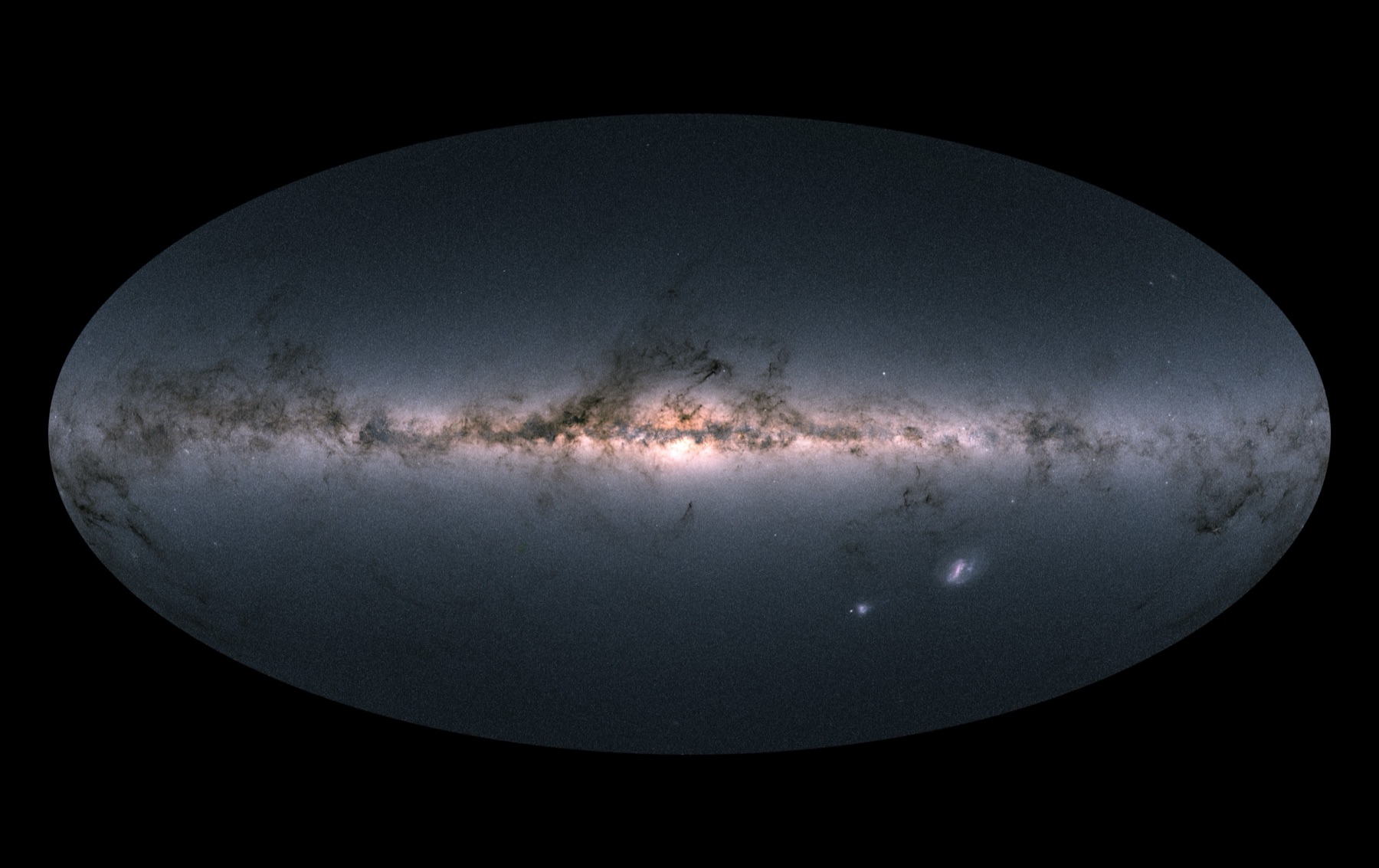
The black hole closest to Earth, as far as anyone knows in October 2026, is Gaia BH1, about 1,560 light-years away. It has about 9.6 times the mass of the Sun and is dormant: it was found in 2022 only through the wobble of a Sun-like star that orbits it every 185.6 days. Closer black holes almost certainly exist but have not been found.
That makes the nearest known black hole a fairly recent discovery, and a fragile record. For what black holes are and how they form, start with our black holes guide.
The nearest known black holes
The three closest confirmed black holes were all found by the European Space Agency’s Gaia mission, which measured the positions and motions of about a billion stars. All three are dormant, meaning nothing is falling into them and they give off no X-rays.
| Black hole | Distance | Mass (Suns) | Companion and orbit | Found |
|---|---|---|---|---|
| Gaia BH1 | About 1,560 light-years (480 parsecs) | 9.6 | Sun-like star, 185.6 days | 2022 |
| Gaia BH3 | About 1,930 light-years (590 parsecs) | 32.7 | Old, metal-poor giant star, 11.6 years | 2024 |
| Gaia BH2 | About 3,800 light-years (1.16 kiloparsecs) | 8.9 | Red giant, 1,277 days | 2023 |
Sources: El-Badry et al. 2023 (MNRAS 518, 1057) for BH1; El-Badry et al. 2023 (MNRAS) for BH2; Gaia Collaboration, Panuzzo et al. 2024 (A&A 686, L2) for BH3.
Gaia BH3 is also the most massive stellar black hole known in the Milky Way. For comparison, Cygnus X-1, the first black hole widely accepted as real in the early 1970s, was found because it shines brightly in X-rays.
How was Gaia BH1 found?
Gaia BH1 was found because its companion star moves in a way no ordinary partner could explain. Kareem El-Badry and colleagues searched Gaia’s 2022 data release for stars whose positions trace small ellipses on the sky, a sign that they orbit something.
One star, very similar to the Sun, was circling an unseen object every 185.6 days. Follow-up spectra measured how fast the star moves toward and away from us, which pins down the mass of its partner: about 9.6 Suns. A normal star of that mass would outshine the Sun-like companion many times over and be obvious in the spectrum. It is not there. Nothing but a black hole fits.
The method matters because it finds black holes that are otherwise invisible. Most known stellar black holes were spotted in X-ray binaries, where a black hole strips gas from a very close companion. Those systems are bright but rare. Gaia BH1 sits on a wide, quiet orbit and eats nothing.
Why closer black holes probably exist
There are almost certainly black holes much closer than 1,560 light-years. NASA notes that around 50 suspected or confirmed stellar-mass black holes have been found through binary systems in the Milky Way, while scientists think there may be as many as 100 million in our galaxy alone.
The numbers point to a large hidden population. If even a tiny fraction of those 100 million lie within a few hundred light-years, some are near us. Most will be single, with no companion star at all, and so cannot be found by the wobble method. The main way to catch them is gravitational microlensing: when a black hole passes in front of a distant star, its gravity briefly bends and brightens the star’s light.
Three things will improve the census:
- Gaia DR4, due on December 2, 2026, covers 66 months of observations, more than earlier releases, which makes longer and smaller wobbles measurable. Gaia BH3 itself turned up in a pre-release check of these data.
- The Roman Space Telescope, launched on August 30, 2026, will watch hundreds of millions of stars toward the center of the galaxy for microlensing events.
- The Vera C. Rubin Observatory, whose 10-year survey began in mid-2026, will catch brightening events across the southern sky.
False alarms: HR 6819 and others
The “closest black hole” title has changed hands before, and not always for good reasons. In 2020 an ESO-led team reported a black hole about 1,000 light-years away in HR 6819, a system visible to the naked eye from the Southern Hemisphere. Other astronomers, including a team at KU Leuven in Belgium, proposed that the data showed two stars instead, one of which had been stripped of much of its mass by the other.
The two teams joined forces and observed the system with ESO’s Very Large Telescope and its interferometer, the VLTI. In a paper published in March 2022 they concluded that HR 6819 contains no black hole: it is a “vampire” pair of stars in a rare, short-lived stage.
Gaia BH1 is a more secure case because its companion is a normal star whose light can be checked directly, and no luminous partner of the right mass hides in the spectrum. Still, treat any “closest black hole” headline carefully until independent teams have confirmed it.
What about the nearest supermassive black hole?
The closest supermassive black hole is Sagittarius A*, at the center of the Milky Way, about 26,000 light-years away. It has about 4.3 million solar masses (GRAVITY collaboration, 2022) and was revealed by stars racing around it, work that earned Andrea Ghez and Reinhard Genzel half of the 2020 Nobel Prize in Physics (Ghez’s 2008 measurement). The Event Horizon Telescope imaged it in 2022 (the image of Sagittarius A*).
Black holes can also hide in star clusters. In 2026 Hubble and Webb found the first stellar-mass black hole in the giant cluster Omega Centauri, about 18,000 light-years away, with 4.46 solar masses (Omega Centauri’s first stellar black hole). Models predict thousands more there.
Should we worry?
No. A black hole of 10 solar masses at 1,560 light-years pulls on Earth far more weakly than the ordinary stars around us. Black holes are dangerous only up close, and the closest known one is roughly 100 million times farther than the Sun. Even in the very far future, the black hole era will arrive slowly, long after the last stars have faded.
Questions people ask
How far away is the nearest black hole?
About 1,560 light-years, or 480 parsecs. That is the distance to Gaia BH1, the nearest black hole confirmed as of October 2026, a dormant black hole of about 9.6 solar masses with a Sun-like companion. The next nearest known, Gaia BH3 and Gaia BH2, are about 1,930 and 3,800 light-years away.
Is there a black hole in our solar system?
No. A black hole in the solar system would betray itself through its gravity, tugging on the planets, asteroids and comets whose orbits are tracked with great precision, and nothing like that is seen. The nearest known black hole, Gaia BH1, is about 1,560 light-years away, roughly 100 million times the Earth-Sun distance.
Can the nearest black hole affect Earth?
No. At 1,560 light-years, the gravity of Gaia BH1 on Earth is far weaker than the pull of ordinary nearby stars, and it is not heading our way. Black holes are not cosmic vacuum cleaners: far from the event horizon, their gravity is the same as any star of the same mass.
How many black holes are in the Milky Way?
NASA says scientists think there may be as many as 100 million stellar-mass black holes in our galaxy, but only about 50 suspected or confirmed ones have been found through binary systems. Most are dormant, with no companion feeding them gas, so they give off no light and are extremely hard to spot.
Was HR 6819 the closest black hole?
It was announced as one in 2020, about 1,000 light-years away, but the claim did not survive. In 2022 the original ESO team and a KU Leuven group, using sharper data from the Very Large Telescope and its interferometer, showed that HR 6819 is a pair of stars in which one stripped gas from the other, with no black hole.
Why are nearby black holes so hard to find?
Because a black hole emits no light of its own. The famous ones, like Cygnus X-1, glow in X-rays only because they pull gas from a close companion star. A black hole with a distant companion, or none, is dark. It can be found only by the way a visible star moves around it, which takes years of precise measurements.
What is the closest supermassive black hole?
Sagittarius A*, at the center of the Milky Way, about 26,000 light-years away. It has about 4.3 million times the mass of the Sun, according to the GRAVITY collaboration in 2022, and the Event Horizon Telescope published the first image of it in May 2022.