Supermassive black holes
A supermassive black hole has hundreds of thousands to billions of solar masses and sits at the center of almost every large galaxy, and how they grew.
By The Orbital Record editorial teamPublished Last reviewed
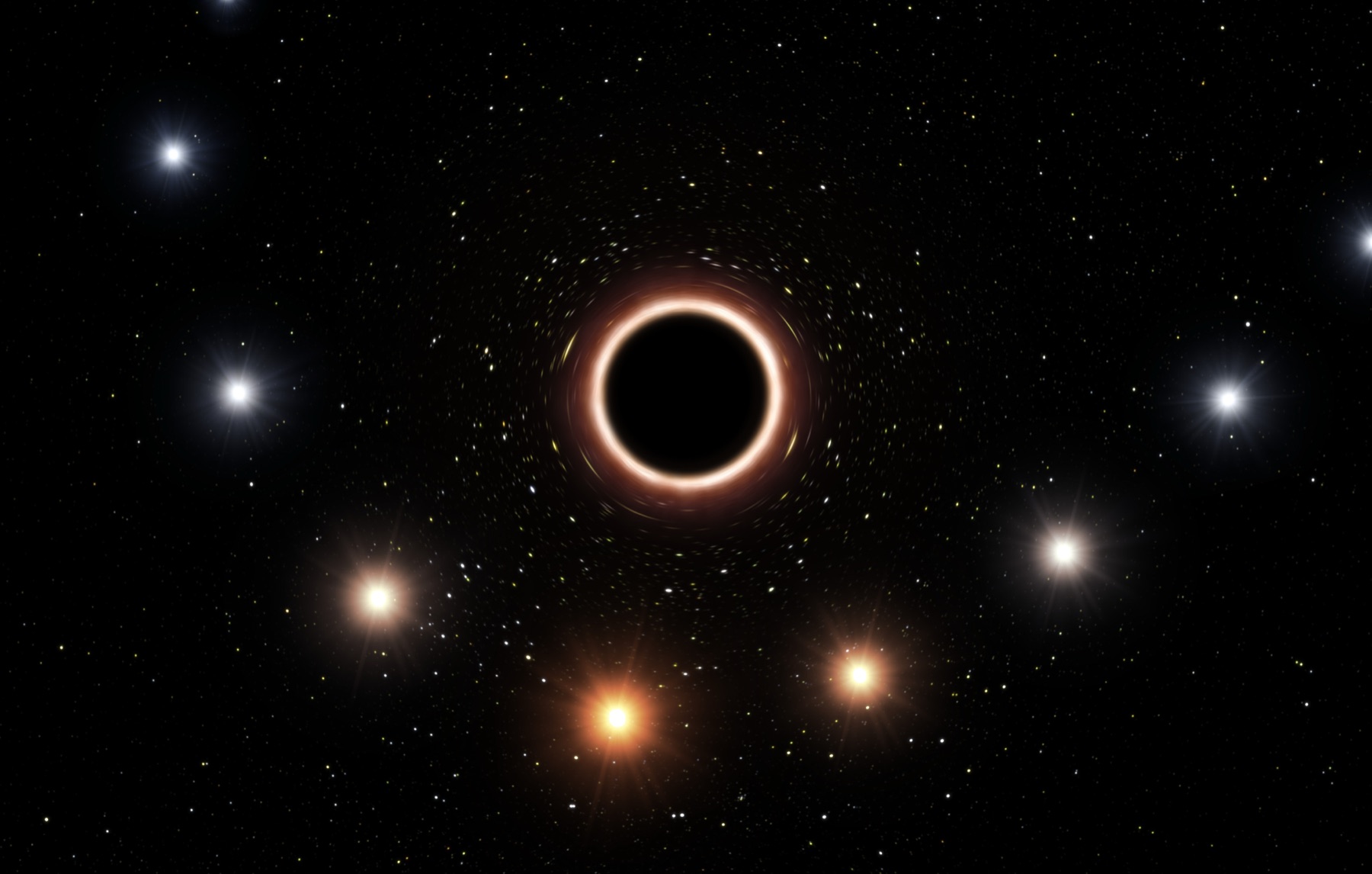
A supermassive black hole is a black hole of hundreds of thousands to billions of times the Sun’s mass, found at the center of almost every large galaxy, including the Milky Way. It differs from an ordinary black hole only in scale: it grew over cosmic history by swallowing gas and merging. When it feeds fast, it becomes a quasar. How some grew so large so early is one of astronomy’s open questions.
Supermassive black holes are one of several kinds of black hole described in our black holes guide.
Supermassive black hole vs black hole
All black holes are regions where gravity is so strong that nothing escapes once inside the event horizon. What differs is mass, and therefore size and origin.
| Stellar-mass black hole | Supermassive black hole | |
|---|---|---|
| Mass | A few to a few tens of Suns (up to hundreds, per NASA) | Hundreds of thousands to billions of Suns |
| How it forms | Collapse of a single massive star | Grows from a seed over billions of years by gas and mergers |
| Where | Scattered through galaxies, often in binaries | At the centers of galaxies |
| Event horizon size | About 6 km across per solar mass: tens of km | Up to hundreds of astronomical units across |
| Example | Gaia BH1, 9.6 Suns | Sagittarius A*, 4.3 million; M87*, 6.5 billion |
| How we find them | X-rays, wobbling companions, gravitational waves | Orbits of stars and gas, quasar light, direct imaging |
A useful rule: a black hole’s horizon radius is about 3 kilometers per solar mass. For M87*, at 6.5 billion Suns, that is roughly 20 billion kilometers, several times the radius of Neptune’s orbit. Between the two classes sit intermediate-mass black holes, which should be the missing link but are hard to confirm. For the nearest small one, see the black hole closest to Earth.
Where are supermassive black holes found?
NASA states that almost every large galaxy has a supermassive black hole at its center. The two best studied:
- Sagittarius A*, at the heart of the Milky Way, about 26,000 light-years away. Tracking stars on tight orbits around it, the GRAVITY collaboration measured 4.30 million solar masses to a precision of about 0.25%. Earlier decades of such orbits, by teams led by Andrea Ghez and Reinhard Genzel, earned half of the 2020 Nobel Prize in Physics (Ghez’s 2008 measurement).
- M87*, in the giant galaxy Messier 87, about 55 million light-years away, with 6.5 billion solar masses. It was the first black hole ever imaged, by the Event Horizon Telescope in 2019 (the first image of a black hole). Sagittarius A* followed in 2022 (the image of Sagittarius A*).
The heaviest are far bigger. The black hole in Holm 15A, the central galaxy of the cluster Abell 85, has about 40 billion solar masses, the most massive with a direct dynamical measurement in the local universe (Mehrgan et al. 2019). A 2025 study of the Cosmic Horseshoe gravitational lens reported one of about 36 billion.
How do black holes and galaxies grow together?
Supermassive black holes are tiny compared with their galaxies, yet their masses track their hosts closely. In 2000, two teams (Ferrarese and Merritt; Gebhardt and colleagues) found that black hole mass rises steeply with the speed at which stars move in the galaxy’s central bulge, a tight link called the M-sigma relation. A 2013 review by Kormendy and Ho put the typical black hole at about 0.5% of its bulge’s mass.
That correlation suggests the two grow together. One proposed link is feedback: when a black hole feeds, the energy it releases can heat or blow away the gas the galaxy needs to form stars, which in turn could starve the black hole.
Quasars: supermassive black holes at full power
A quasar is a supermassive black hole swallowing gas so fast that the disk of matter spiraling into it outshines its entire galaxy. NASA describes luminosities 10 to 100,000 times that of the Milky Way, generated in a region light-days to light-years across. Maarten Schmidt identified the first in 1963, when he showed that the “star” 3C 273 had a redshift of 0.158, placing it far beyond the Milky Way (the discovery of quasars).
There is a practical ceiling on feeding, the Eddington limit: above a certain brightness, the pressure of the escaping light pushes infalling gas away. The limit scales with mass, about 1038 ergs per second per solar mass, and in practice can be exceeded only by modest factors.
How did supermassive black holes get so big so early?
This is the central puzzle. Quasars powered by black holes of about a billion solar masses already existed in the first billion years after the Big Bang, and Euclid and Keck doubled the number of known quasars beyond redshift 7 in 2026 (the earliest quasars). Growing that big that fast is hard from a small start.
There are two families of answers, summarized in a 2023 Nature Astronomy paper:
- Light seeds. The black holes left by the first stars, about 10 to 100 solar masses, which would need to feed almost nonstop, sometimes above the Eddington limit.
- Heavy seeds. Black holes of about 10,000 to 100,000 solar masses formed directly from collapsing gas clouds, giving growth a head start.
JWST and Chandra are now catching black holes in the act. UHZ1, seen about 500 million years after the Big Bang, holds a black hole of roughly 10 to 100 million solar masses, comparable to the mass of all the stars in its galaxy, which its discoverers saw as consistent with a heavy seed (Bogdán et al. 2023). In GN-z11, at redshift 10.6, JWST found a black hole of about 1.6 million solar masses feeding at about five times the Eddington rate (GN-z11’s early black hole), consistent with either route. And the population of little red dots may be young supermassive black holes growing inside dense cocoons of gas.
When supermassive black holes merge
When galaxies merge, their central black holes sink together and form binaries that orbit for millions of years. In 2023 NANOGrav reported evidence for a background of very long gravitational waves from 15 years of pulsar timing (NANOGrav’s 15-year evidence). Models of supermassive black hole binary populations reproduce its amplitude and shape, though other sources cannot yet be excluded. The planned LISA mission, due in the mid-2030s, should hear individual supermassive black holes merge. More in our gravitational waves guide.
Questions people ask
What is the difference between a supermassive black hole and a black hole?
A supermassive black hole is a black hole, just a far heavier one. Stellar-mass black holes form when single massive stars collapse and weigh a few to a few tens of Suns. Supermassive ones weigh hundreds of thousands to billions of Suns, sit at the centers of galaxies and grew over billions of years by swallowing gas and merging.
What is the largest black hole?
Among those with a direct measurement, the heaviest in the nearby universe is the black hole in the galaxy Holm 15A, about 40 billion solar masses (Mehrgan et al. 2019). A 2025 study of the Cosmic Horseshoe lens found one of about 36 billion. These figures carry large uncertainties and records can change as methods improve.
Is there a supermassive black hole in the Milky Way?
Yes. Sagittarius A*, at the center of our galaxy about 26,000 light-years away, has about 4.3 million times the Sun's mass, measured from the orbits of nearby stars by the GRAVITY collaboration. Andrea Ghez and Reinhard Genzel shared half of the 2020 Nobel Prize in Physics for discovering it.
How do supermassive black holes form?
Nobody knows for certain. They may have started as light seeds, the 10 to 100 solar-mass remains of the first stars, or as heavy seeds of 10,000 to 100,000 solar masses formed by the direct collapse of gas clouds. Either way they grew by swallowing gas and merging with other black holes as their galaxies merged.
Can a supermassive black hole swallow a galaxy?
No. Even a very massive black hole is tiny compared with its galaxy, typically about half a percent of the mass of the galaxy's central bulge. Stars orbit it the way planets orbit the Sun. Only gas and stars that stray very close fall in; the rest of the galaxy is safe.
What is a quasar?
A quasar is a supermassive black hole feeding so fast that the gas spiraling into it outshines its whole galaxy. NASA says quasars can be 10 to 100,000 times as luminous as the Milky Way, from a region only light-days to light-years across. Maarten Schmidt identified the first, 3C 273, in 1963.