Is the universe infinite?
Nobody knows. The observable universe is 93 billion light-years across and space is flat to within 0.2%, which allows, but does not prove, infinity.
By The Orbital Record editorial teamPublished Last reviewed
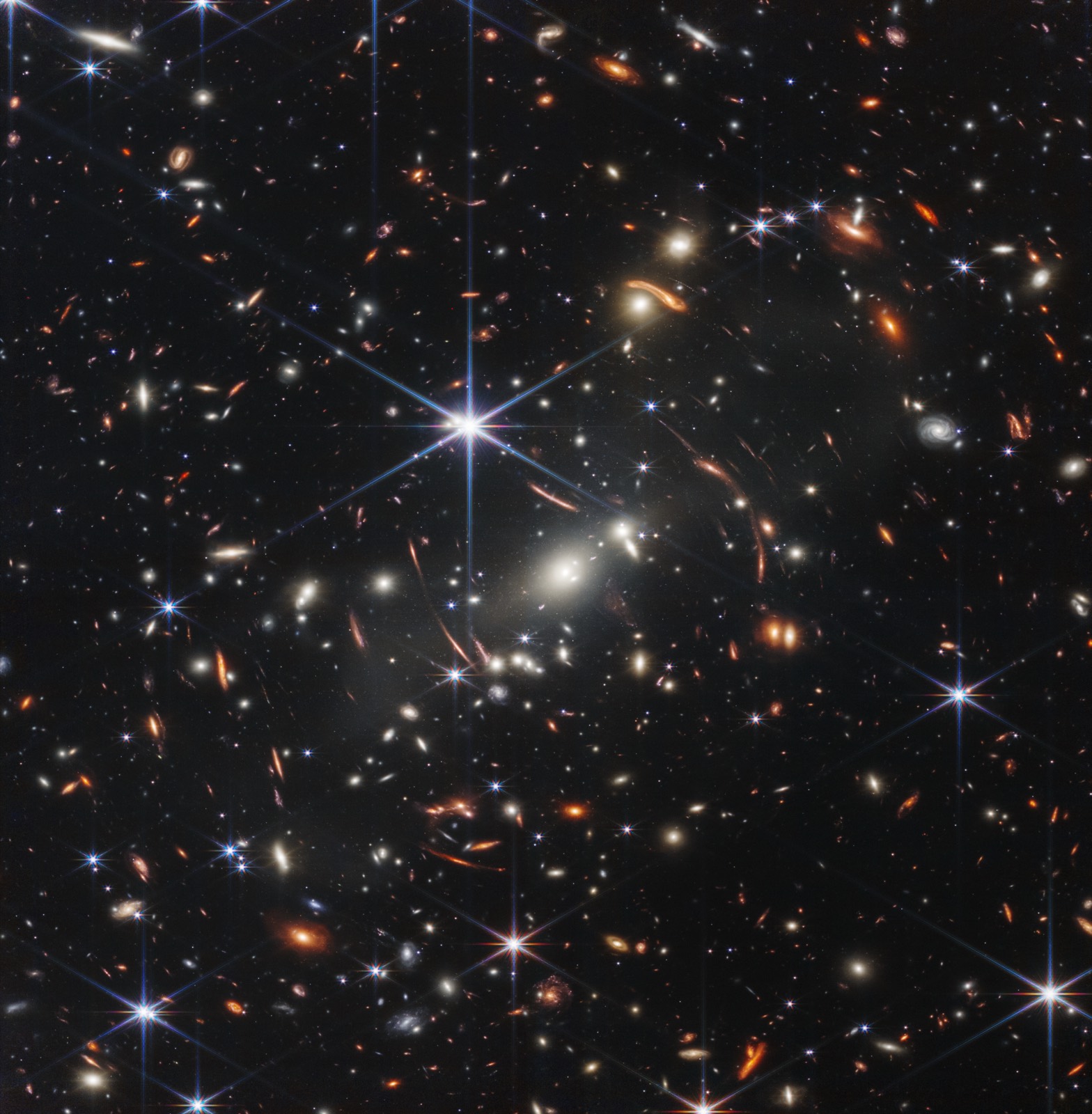
Nobody knows if the universe is infinite. The observable universe is finite, about 93 billion light-years across, but it is only the part whose light has reached us. Measurements show space is flat to within 0.2%, and a flat universe can be infinite. It could also be finite but vastly larger than what we see.
This is a question where cosmology gives a precise partial answer and an honest limit. Here is what is measured, what is inferred, and what may stay out of reach.
The observable universe vs the whole universe
The observable universe and the universe are not the same thing. The observable universe is a sphere centered on us, defined by how far light could have traveled since the Big Bang. Every observer, in every galaxy, has their own observable universe, just as every ship at sea has its own horizon.
Its size is surprisingly large. The universe is 13.8 billion years old, yet the observable universe is about 93 billion light-years in diameter. The reason is expansion: while ancient light was crossing toward us, the space it crossed kept stretching. The material that emitted the cosmic microwave background, 380,000 years after the Big Bang, is now roughly 46 billion light-years away.
The whole universe includes everything beyond that horizon. Since the universe looks the same in every direction we check, cosmologists expect the unseen regions to look like ours: more galaxies, more clusters, the same physics.
Is the universe flat? How we measure the shape of space
The universe is flat to the precision of current measurements. In general relativity, matter and energy can curve space as a whole. There are three possibilities, and each one has different consequences for size:
| Geometry | Curvature value | Triangle angles add up to | Size | Status |
|---|---|---|---|---|
| Flat | Zero | Exactly 180 degrees | Infinite, unless space wraps around | Consistent with all data |
| Closed (spherical) | Positive | More than 180 degrees | Finite, with no edge | Allowed only if curvature is very slight |
| Open (saddle-shaped) | Negative | Less than 180 degrees | Infinite | Allowed only if curvature is very slight |
How do you measure the angles of a triangle billions of light-years across? The cosmic microwave background provides one. Sound waves in the early universe left spots of a known physical size, and their apparent size on the sky depends on whether space is flat, closed or open. Baryon acoustic oscillations, the same ruler imprinted in the distribution of galaxies, provide a second triangle at a different distance.
Combining both, the Planck collaboration measured a curvature parameter of 0.0007 ± 0.0019 (Planck 2018 cosmological parameters). Zero is well inside the error bar. In Planck’s words, the universe is “spatially flat to a 1 sigma accuracy of 0.2 %.”
Does flat mean infinite?
Not necessarily, for two reasons.
First, measurement can never prove exactly zero. A universe with tiny positive curvature, below our error bars, would be closed and finite, just so large that it looks flat to us, the way a small patch of Earth looks flat. Future surveys such as ESA’s Euclid and DESI will shrink the error bars, but there will always be one.
Second, a flat space can still be finite if it connects back to itself, like the screen of an old arcade game where leaving on the right brings you back on the left. Mathematicians call this a non-trivial topology. If the universe were small enough to wrap around within our view, we would see the same patch of the microwave background in more than one direction, as matched circles on the sky.
Planck searched for exactly that. Its 2015 analysis found no sign of a wrapped-around topology on scales smaller than the diameter of the visible microwave sky. In plain words: if the universe wraps around, it does so on a scale at least comparable to the observable universe, so we cannot see the repeat.
What we can say with confidence
Putting the evidence together:
- The observable universe is finite: about 93 billion light-years across.
- Space is flat to within about 0.2%, as of the Planck 2018 analysis.
- If the universe is finite, it is much larger than what we can see, and it has no edge.
- If it is infinite, it has always been infinite. The Big Bang did not happen at a point; it happened everywhere in an already infinite space.
- We may never know for sure, because some of the universe will always lie beyond our horizon.
Point 4 is worth a second look. An infinite universe does not “grow into” anything. The Big Bang, in that case, was a hot, dense state filling infinite space, and expansion means the distances between all points have grown since.
What about infinite copies of you?
You may have read that an infinite universe must contain identical copies of Earth and of you. The argument is statistical: if space is infinite and matter is arranged randomly within the laws of physics, every arrangement that can happen will happen somewhere, infinitely often. Some cosmologists take it seriously; others note that it rests on assumptions about infinity and probability that cannot be tested. It is a consequence of a hypothesis, not an observation.
The universe we can see is shrinking
A twist: because the expansion of the universe is accelerating, distant galaxies are slowly slipping beyond our reach. In a 2007 paper Lawrence Krauss and Robert Scherrer calculated that, in the standard model, everything outside our Local Group of galaxies will be carried out of view on a timescale of order 100 billion years (the return of a static universe). Future astronomers would see one merged galaxy and no evidence that the universe is expanding at all.
So whether or not the universe is infinite, the part anyone can see will shrink. What happens next depends on dark energy, the subject of our dark energy guide, and the very long view is mapped in Deep Time. For the other end of the timeline, see what came before the Big Bang.
Questions people ask
Is the universe infinite?
Nobody knows. The part we can observe is finite, about 93 billion light-years across. Measurements show space is flat to within about 0.2%, and a flat universe can be infinite, but it could also be finite yet enormous, or curved slightly beyond what we can detect. The question may never be fully settled.
How big is the observable universe?
The observable universe is about 93 billion light-years in diameter. Light from its edge has traveled for nearly 13.8 billion years, but space kept expanding during that time, so the regions that emitted it are now roughly 46 billion light-years away in every direction.
Is the universe flat?
As far as we can measure, yes. Combining Planck's cosmic microwave background maps with baryon acoustic oscillation data gives a curvature of 0.0007 plus or minus 0.0019, consistent with zero. In a flat universe, parallel lines never meet and the angles of a triangle add up to 180 degrees on cosmic scales.
What is beyond the observable universe?
Almost certainly more universe much like ours: more galaxies, spread just as evenly. The observable universe is a limit set by how far light has traveled since the Big Bang, not a physical boundary. We cannot see beyond it, so its contents can only be inferred.
Does the universe have an edge?
No known model of the universe has an edge. An infinite universe goes on forever, and a finite one could close back on itself like the surface of a sphere or a video game screen that wraps around. In either case there is no wall and no outside to fall into.
How can the observable universe be 93 billion light-years wide if it is 13.8 billion years old?
Nothing traveled faster than light through space. Space itself expanded while the light was in transit. The oldest light we receive left its source 13.8 billion years ago, but the stretching of space since then has carried that source to about 46 billion light-years away, doubled to 93 billion across.