2022
JWST Transiting Exoplanet Community Early Release Science Team, Nature, 614, 649-652, 2022
WASP-39b (2022): Webb Detects CO2 in an Exoplanet Atmosphere
Detected in 2022 carbon dioxide in an exoplanet's air for the first time, on the gas giant WASP-39b. Webb's Early Release Science team saw it at 26 sigma.
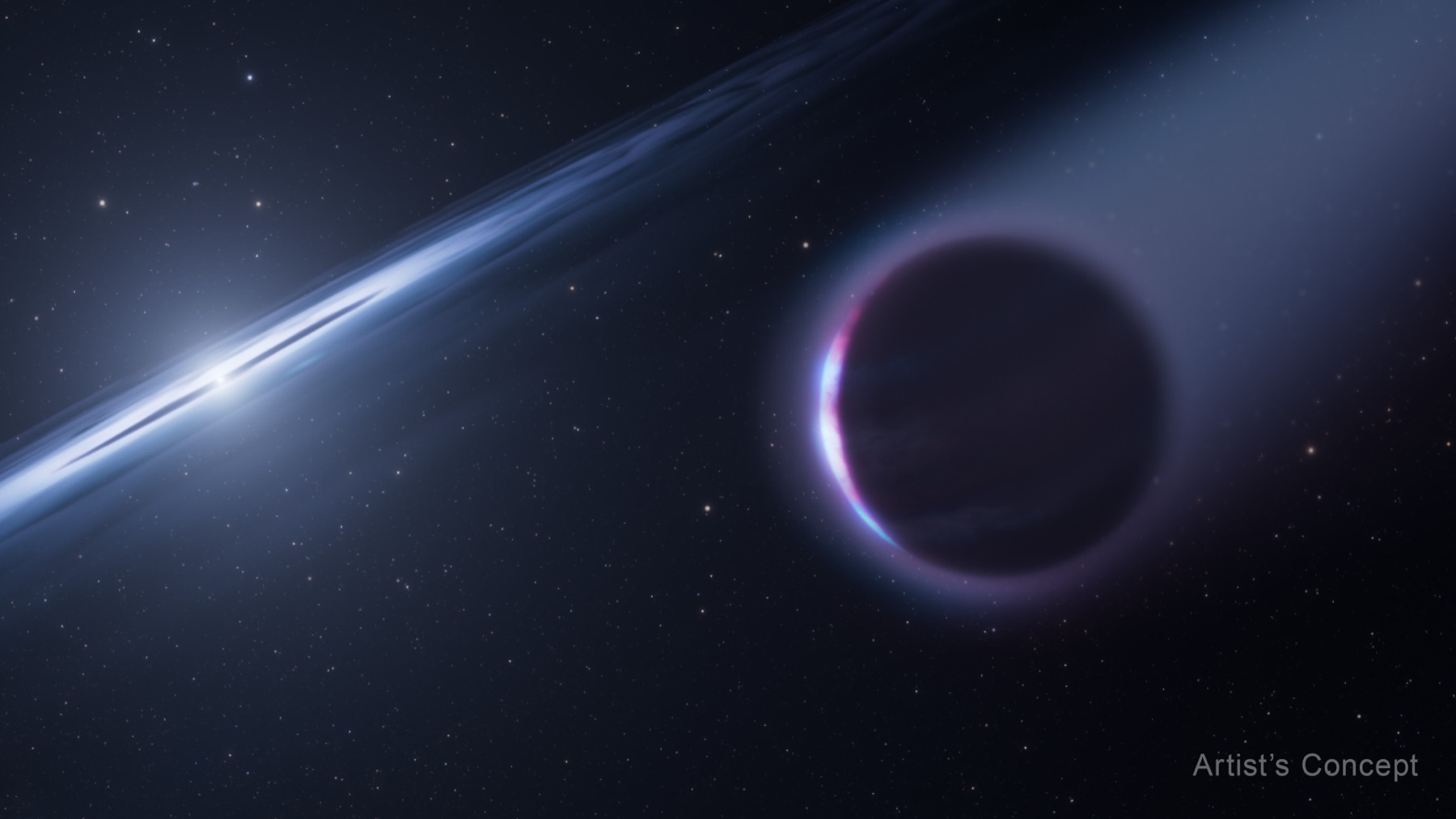
The James Webb Space Telescope’s Early Release Science team detected carbon dioxide on the gas giant WASP-39b in 2022, the first definitive detection of CO2 in an exoplanet atmosphere. The signal was overwhelming, at 26 sigma, and showed Webb could read exoplanet chemistry with new clarity.
The question
Carbon dioxide turns up in a wide range of planetary atmospheres, including Earth’s. For exoplanets it is especially useful: in a hot gas giant, the amount of CO2 tracks the atmosphere’s “metallicity”, the share of elements heavier than helium, and that is a clue to how the planet formed. Earlier measurements with NASA’s Spitzer Space Telescope had hinted at CO2 on other planets but never pinned it down, because they could not separate its fingerprint from other molecules. Webb, launched in December 2021, was designed to do better.
What the paper found
- A clear CO2 feature. The spectrum shows a strong absorption band at 4.3 micrometers, the signature of carbon dioxide.
- Detected at 26 sigma. Sigma measures how unlikely a signal is to be random noise. Physicists usually call 5 sigma a discovery; 26 sigma leaves no realistic doubt.
- A first. It was the first definitive detection of CO2 in an exoplanet atmosphere.
- Clues to formation. The whole spectrum matches models with about 10 times the Sun’s share of heavy elements and moderate clouds. Those models predict water, carbon monoxide and hydrogen sulfide too, but little methane.
- A loose end. The team also tentatively saw a small feature near 4.0 micrometers that the models did not reproduce.
How they did it
The team used transmission spectroscopy with Webb’s NIRSpec instrument, covering wavelengths from 3.0 to 5.5 micrometers. WASP-39b passes in front of its star on every orbit. During each transit, a thin ring of starlight filters through the planet’s atmosphere on its way to us. Molecules in that air absorb light at their own characteristic wavelengths, so the planet looks very slightly larger at those colors. Comparing the starlight during and outside the transit, wavelength by wavelength, gives a spectrum of the atmosphere.
The observations were part of Webb’s Early Release Science program, one of the telescope’s first science projects.
Why it mattered
This was among the first scientific demonstrations of how well the James Webb Space Telescope can read the chemistry of exoplanet atmospheres. Hot gas giants like WASP-39b, the class first found with the 1995 discovery of 51 Pegasi b, are the easiest targets because they are big and hot. Showing that Webb could nail their composition opened the door to the far harder job of studying smaller, cooler worlds. Webb’s overall early performance is described in the 2023 JWST science performance report, and highlights are collected in our guide to JWST discoveries.
What we know now
The same technique is now being applied to smaller and cooler exoplanets, including the TRAPPIST-1 planets and K2-18 b, where a 2023 study reported methane and carbon dioxide along with claims that remain disputed.
Who wrote it
The paper is credited first to the JWST Transiting Exoplanet Community Early Release Science Team as a whole, followed by named authors beginning with Eva-Maria Ahrer and Lili Alderson. It appeared online in Nature on 2 September 2022, less than a year after Webb’s launch.
Read the original
JWST Transiting Exoplanet Community Early Release Science Team, Ahrer, E.-M., Alderson, L., et al. (2022). “Identification of carbon dioxide in an exoplanet atmosphere.” Nature 614, 649-652 (issue dated February 2023). doi:10.1038/s41586-022-05269-w
Free to read: arXiv preprint.
This week in papers
Five new results in one line each, plus one landmark like this one. Weekly.
Keep reading
Fulton et al., The Astronomical Journal, 154, 109, 2017
The Fulton Gap: A Missing Size of Small Planets
Found in 2017 a gap in the sizes of small planets between 1.5 and 2 Earth radii. Fulton's team split close-in worlds into super-Earths and sub-Neptunes.
Gillon et al., Nature, 542, 456-460, 2017
TRAPPIST-1: Seven Earth-Size Planets Around One Star
Found in 2017 seven Earth-size planets transiting TRAPPIST-1, a tiny star 40 light-years away. Gillon's team showed several could hold liquid water.
Anglada-Escudé et al., Nature, 536, 437-440, 2016
Proxima b: A Temperate Planet Around the Nearest Star
Found in 2016 Proxima b, a planet of at least 1.3 Earth masses orbiting the nearest star. Anglada-Escudé's team caught the star wobbling every 11.2 days.
Topic guide
Exoplanets
Recent news in exoplanets