Roman Space Telescope vs James Webb
Webb zooms deep with a 6.5 m mirror; Roman, launched in August 2026, maps wide with a field 100 times larger. How the two infrared telescopes compare.
By The Orbital Record editorial teamPublished Last reviewed
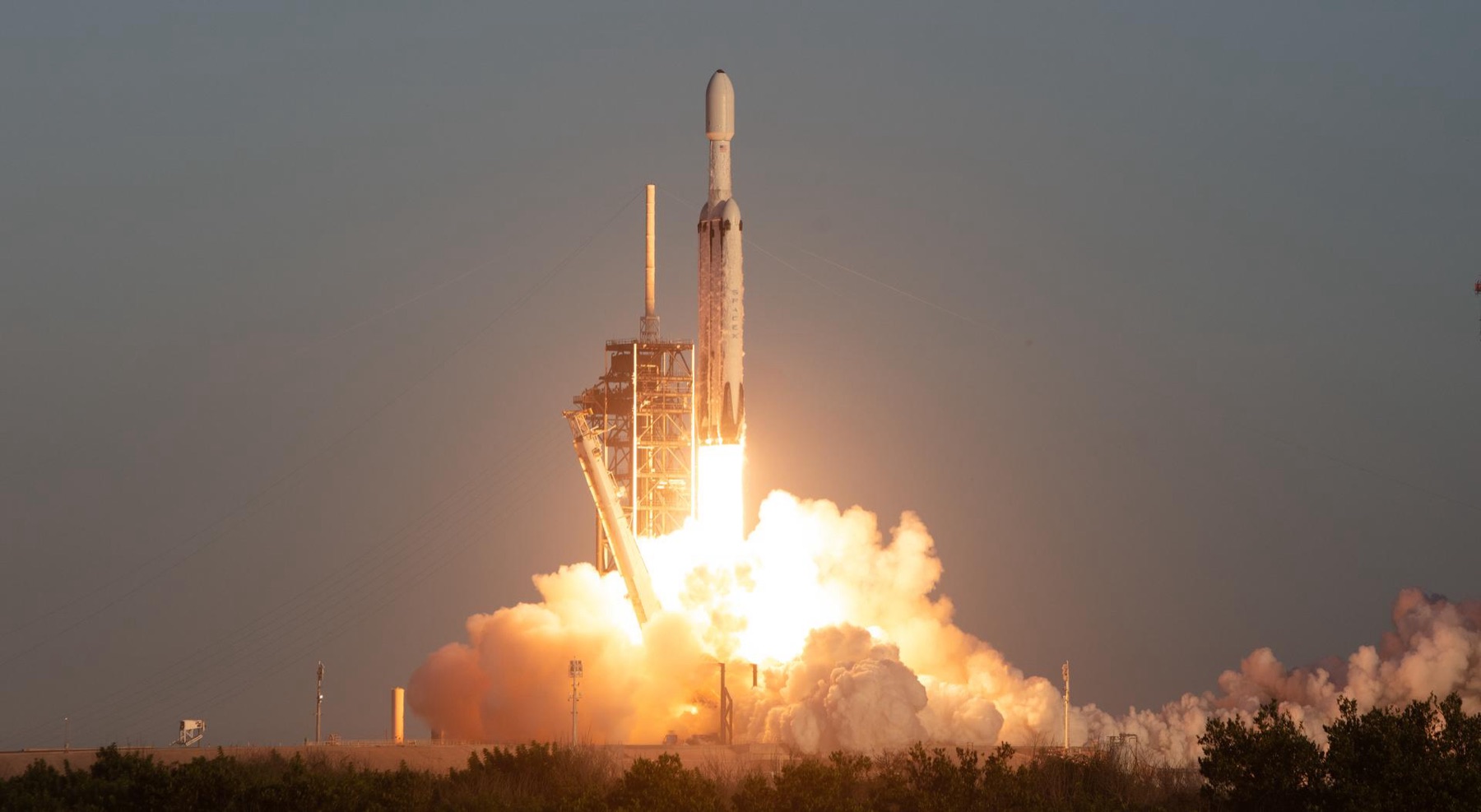
The Roman Space Telescope and the James Webb Space Telescope are both NASA infrared observatories near the Sun-Earth L2 point, but they do opposite jobs: Webb zooms deep into single targets with a 6.5-meter mirror, while Roman, launched on August 30, 2026, maps huge areas of sky with a field of view about 100 times larger than Webb’s main camera. Roman finds; Webb examines.
The comparison matters now because Roman is the newest large telescope in space, and most pages still describe it as “upcoming”. For the wider fleet, see our space telescopes and observatories guide.
Roman vs Webb at a glance
| James Webb Space Telescope | Nancy Grace Roman Space Telescope | |
|---|---|---|
| Launched | December 25, 2021 (Ariane 5) | August 30, 2026 (Falcon Heavy) |
| Primary mirror | 6.5 m, 18 gold-coated segments | 2.4 m, single mirror (same size as Hubble’s) |
| Wavelengths | 0.6 to 28.5 micrometers | 0.48 to 2.3 micrometers (Wide Field Instrument) |
| Field of view | Small, built for depth | 0.281 square degrees, about 100 times the area of Webb’s NIRCam or Hubble’s ACS |
| Main camera | NIRCam and MIRI | 300-megapixel Wide Field Instrument, 18 detectors |
| Location | Sun-Earth L2 | Sun-Earth L2 (arriving late 2026) |
| Style | Pointed observations of chosen targets | Large surveys of the same sky over and over |
| Status, October 2026 | Science operations since July 2022 | Commissioning; first images expected by early 2027 |
Sources: NASA, Space Telescope Science Institute (Roman user documentation).
The key difference: field of view
Roman’s defining feature is its field of view. Each Roman image covers a patch of sky larger than the full Moon. The active area of its Wide Field Instrument is 0.281 square degrees, roughly 100 times the area covered by Webb’s NIRCam camera or Hubble’s Advanced Camera for Surveys, and about 200 times that of Hubble’s Wide Field Camera 3 in the infrared.
NASA says that over its first five years Roman will image more than 50 times as much sky as Hubble covered in its first 30 years, and that it can survey the sky 1,000 times faster than Hubble at similar sensitivity and infrared resolution. Webb could not do that: its strength is depth, with a mirror that collects more than six times as much light as Hubble’s. Webb is the telescope you use once you know where to look.
Mirrors and wavelengths
Webb’s 6.5-meter mirror and its reach to 28.5 micrometers let it see the faintest, most distant galaxies, cool dust and the heat of exoplanet atmospheres. Our JWST vs Hubble comparison explains why infrared matters.
Roman’s mirror is 2.4 meters, the same size as Hubble’s. It was donated by the National Reconnaissance Office. Roman sees from the visible into the near-infrared, 0.48 to 2.3 micrometers, so it overlaps with the short-wavelength end of Webb’s range but goes nowhere near Webb’s mid-infrared. Each Roman pixel covers 0.11 arcseconds of sky. Webb, with its larger mirror, resolves finer detail.
What about Roman vs Hubble?
Roman is closer to Hubble than to Webb in hardware, and that is deliberate. It has a Hubble-sized 2.4-meter mirror, and when NASA named the mission in 2020 it described Roman as “Hubble’s wide-eyed cousin”: just as sensitive as Hubble’s cameras, but imaging a sky area 100 times larger, so that a single Roman image holds the detail of about 100 Hubble pictures.
The differences are the wavelengths and the orbit. Hubble sees mainly ultraviolet and visible light from low Earth orbit, a few hundred kilometers up, where Space Shuttle crews serviced it five times between 1993 and 2009. Roman works in the near-infrared from L2, far beyond any repair mission, which keeps it cold and gives it an uninterrupted view of the sky. Hubble remains the only one of the three that sees ultraviolet light.
What each telescope is for
Webb is a general-purpose observatory. Astronomers compete for time on specific targets: the earliest galaxies, the atmospheres of planets such as WASP-39b, or the little red dots. Our roundup of JWST discoveries tracks the results.
Roman is a survey machine with three headline goals:
- Dark energy. By mapping galaxies and distant supernovae across wide areas, Roman will measure how cosmic expansion has changed over time. It joins Euclid and the Rubin Observatory in testing whether dark energy is weakening, as DESI’s 2025 results hint.
- Dark matter. Weak gravitational lensing, the tiny distortion of background galaxies by matter in front of them, will map where dark matter sits.
- Exoplanets. The Galactic Bulge Time Domain Survey will watch hundreds of millions of stars toward the center of the Milky Way every 12 minutes, across six seasons spread over five years and 438 days of observing. NASA expects more than 1,000 new planets from microlensing alone, including planets on wide orbits and possibly free-floating “rogue” planets.
Roman also carries a Coronagraph Instrument that blocks starlight to test technology for directly imaging planets like Jupiter around other stars, a step toward the proposed Habitable Worlds Observatory.
How they will work together
The two telescopes are complementary by design. Roman will sweep large areas and flag rare objects: distant supernovae, unusual galaxies, microlensing events, faint companions. Webb can then point at the most interesting ones and take detailed spectra. Webb already does the same with targets found by Euclid and ground surveys.
Roman will also send down far more data: about 1.4 terabytes every day, all of it made public as soon as it is processed. Over its lifetime it could measure light from a billion galaxies.
What to watch next
Roman’s next milestones are concrete: arrival at L2 and the end of commissioning in late 2026, then first images, which NASA expects by early 2027. Its five-year prime mission follows. Webb, which launched with enough propellant for about 20 years, will still be working through Roman’s prime mission. Launch details are in our Roman launch report and on the Roman Space Telescope hub.
Questions people ask
Is the Roman Space Telescope better than James Webb?
Neither is better overall; they do different jobs. Webb has a much larger mirror and sees farther into the infrared, so it studies single targets in great depth. Roman has a field of view about 100 times larger than Webb's main camera, so it maps huge areas of sky quickly. Many Roman discoveries will be followed up by Webb.
When did the Roman Space Telescope launch?
Roman launched on August 30, 2026, at 7:26 a.m. EDT on a SpaceX Falcon Heavy from Launch Complex 39A at NASA's Kennedy Space Center. As of October 2026 it is commissioning on the way to the Sun-Earth L2 point, and NASA expects to release its first images by early 2027.
How big is Roman's mirror compared with Webb's?
Roman's primary mirror is 2.4 meters across, the same size as Hubble's; it was donated to NASA by the National Reconnaissance Office. Webb's segmented mirror is 6.5 meters across. Webb therefore collects far more light from each target and sees finer detail, while Roman trades size for a much wider view.
What will the Roman Space Telescope discover?
Roman is built for three main goals: measuring how dark energy has shaped cosmic expansion, mapping dark matter through its gravity, and taking a census of planets around other stars. NASA expects more than 1,000 new planets from microlensing alone, and the telescope could measure light from a billion galaxies over its lifetime.
Where are Roman and Webb in space?
Both work near the Sun-Earth L2 point, about 1.5 million kilometers from Earth on the side away from the Sun. There, a sunshade can block the Sun, Earth and Moon at once, keeping infrared instruments cold and stable. Roman needs about three months to reach L2 after its August 2026 launch.
Why is it called the Nancy Grace Roman Space Telescope?
It honors Nancy Grace Roman, NASA's first chief astronomer, who campaigned for telescopes in space that could study the wider universe. NASA calls her the mother of the Hubble Space Telescope. The mission was known as WFIRST, the Wide Field Infrared Survey Telescope, until NASA renamed it on May 20, 2020.