The most Earth-like exoplanets
No known exoplanet is a proven Earth twin. The leading candidates, from Teegarden's Star b to TRAPPIST-1 e, compared, with what JWST has found.
By The Orbital Record editorial teamPublished Last reviewed
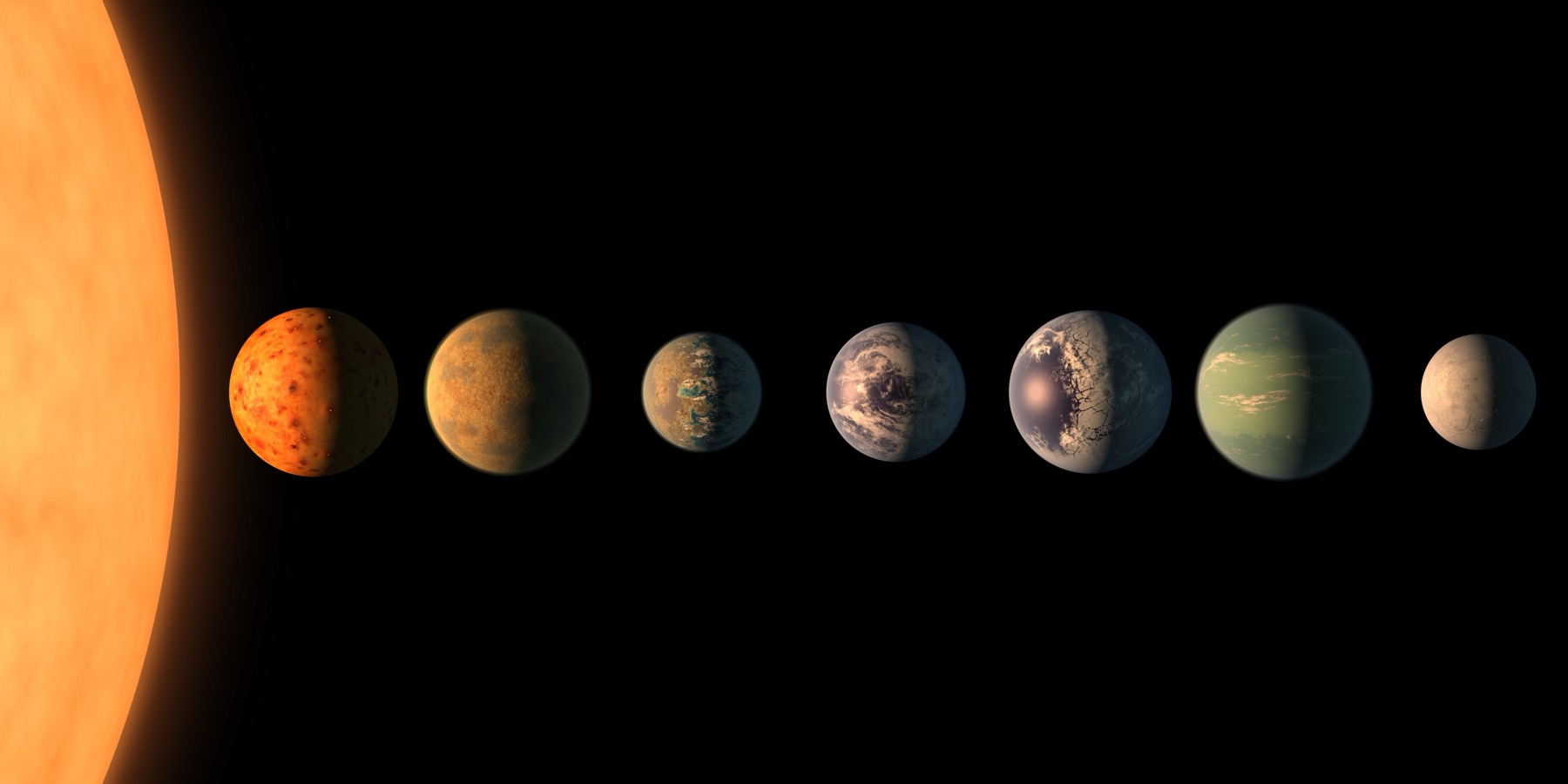
No exoplanet is yet known to be a true Earth twin. The best candidates are rocky-sized planets in their star’s habitable zone: Teegarden’s Star b and TOI-700 d score highest on similarity, Proxima b is the nearest, and TRAPPIST-1 e and LHS 1140 b are the most studied by JWST. None has a confirmed atmosphere or water.
“Earth-like” in headlines usually means only two things: roughly Earth’s size and roughly Earth’s starlight. The background on how these planets are found is in our exoplanets guide.
What makes an exoplanet “Earth-like”?
Astronomers can usually measure only a few things about a distant small planet:
- Size or mass. Planets up to about 1.5 times Earth’s radius are likely rocky; above about 2, most have thick gas envelopes (the radius gap).
- Starlight received. A planet in the habitable zone receives enough energy that liquid water could exist on its surface, in principle (Kasting et al. 1993).
- Atmosphere. Only now measurable for a handful of small planets, with JWST.
The Earth Similarity Index (ESI), introduced by Dirk Schulze-Makuch and colleagues in 2011, combines radius, density, escape velocity and temperature into a score from 0 to 1. Critics, including a 2017 Nature Astronomy commentary by Elizabeth Tasker and colleagues, point out that similar size and sunlight say nothing about whether a planet has air, water or plate tectonics. Treat the ESI as a shortlist, not a verdict.
The leading candidates, compared
Values from NASA’s Exoplanet Archive (October 2026). For planets found by the radial velocity method, the mass is a minimum and the radius is an estimate. ESI values are from the Planetary Habitability Laboratory’s catalog.
| Planet | Distance (light-years) | Radius (Earth = 1) | Mass (Earth = 1) | Orbit (days) | Star | Found | ESI |
|---|---|---|---|---|---|---|---|
| Teegarden’s Star b | 12.5 | About 1.05 (est.) | At least 1.16 | 4.9 | Red dwarf | 2019 | 0.97 |
| TOI-700 d | 101 | 1.14 | About 1.6 (est.) | 37.4 | Red dwarf | 2020 | 0.94 |
| Kepler-1649 c | 301 | 1.06 | About 1.2 (est.) | 19.5 | Red dwarf | 2020 | 0.93 |
| TOI-700 e | 101 | 0.92 | About 0.7 (est.) | 27.8 | Red dwarf | 2023 | 0.91 |
| TRAPPIST-1 d | 40.5 | 0.79 | 0.39 | 4.05 | Ultracool dwarf | 2016 | 0.91 |
| TRAPPIST-1 e | 40.5 | 0.92 | 0.69 | 6.10 | Ultracool dwarf | 2017 | |
| Proxima b | 4.2 | About 1.0 (est.) | At least 1.06 | 11.2 | Red dwarf | 2016 | 0.86 |
| Ross 128 b | 11.0 | About 1.1 (est.) | At least 1.40 | 9.9 | Red dwarf | 2017 | 0.86 |
| Gliese 12 b | 39.8 | 0.93 | 0.95 | 12.8 | Red dwarf | 2024 | |
| Wolf 1069 b | 31.3 | About 1.1 (est.) | At least 1.26 | 15.6 | Red dwarf | 2023 | |
| LHS 1140 b | 48.9 | 1.73 | 5.6 | 24.7 | Red dwarf | 2017 | |
| Kepler-452 b | About 1,800 | 1.63 | Not measured | 385 | Sun-like (G2) | 2015 |
A blank ESI cell means the planet is not in the catalog’s top list or its score is not given there. Gliese 12 b receives more starlight than Earth and sits near the hot inner edge of habitability, closer to a Venus analog.
The candidates in brief
Teegarden’s Star b
Teegarden’s Star is a tiny, faint red dwarf just 12.5 light-years away. Its planet b, found by the radial velocity method in 2019, has at least 1.16 Earth masses and receives similar starlight to Earth, which gives it the highest ESI in the catalog. It does not transit, so its atmosphere cannot be probed with today’s transit techniques.
TOI-700 d and e
NASA’s TESS found two habitable-zone planets around the red dwarf TOI-700: d in 2020 and the slightly smaller e in 2023. Both are close to Earth’s size. The star is relatively quiet, which makes them interesting, but at 101 light-years they are faint targets.
TRAPPIST-1 e (and its siblings)
TRAPPIST-1, about 40 light-years away, has seven Earth-sized planets (Gillon et al. 2017), and e, f and g lie in or near the habitable zone. JWST has studied the system more than any other rocky-planet system:
- TRAPPIST-1 b (2023): a dayside of about 500 K with no significant atmosphere, consistent with bare rock.
- TRAPPIST-1 c (2023): rules out thick carbon dioxide atmospheres; bare rock or a thin atmosphere remain possible.
- TRAPPIST-1 d (2025): no Earth-like atmosphere detected; at most a thin one or high clouds.
- TRAPPIST-1 e (2025): four transits rule out a hydrogen-dominated atmosphere. A nitrogen-rich atmosphere like Earth’s is still allowed, but bare rock is not excluded. About 15 more transits are planned.
Proxima b
The nearest exoplanet, 4.2 light-years away, found in 2016 by ESO’s “Pale Red Dot” campaign (Anglada-Escudé et al. 2016). It orbits in the habitable zone but does not transit, and its star blasts it with flares. Future giant telescopes may detect its thermal glow or reflected light directly.
LHS 1140 b
A super-Earth or water world about 49 light-years away, LHS 1140 b is heavier (5.6 Earth masses) and larger (1.73 Earth radii) than Earth, so it is not a twin, but it is one of the best habitable-zone targets. JWST data published in 2024 ruled out a hydrogen-rich atmosphere and gave a tentative hint of nitrogen, consistent with a water world or a “snowball” with an ocean facing its star. In July 2026 a Science paper reported escaping helium seen from the ground; an August 2026 preprint using four JWST transits argued strongly against that signal. Treat any atmosphere claim as unconfirmed.
Kepler-452 b, Kepler-186 f and Kepler-442 b
Kepler’s famous habitable-zone finds (the Kepler mission) are hundreds to about 1,800 light-years away. Kepler-452 b orbits a Sun-like star in 385 days but is 1.6 times Earth’s width; Kepler-186 f (2014) was the first Earth-sized planet found in a habitable zone. They are too far for atmosphere studies.
Why “most like Earth” is still an open question
Three gaps keep any ranking provisional:
- Atmospheres. Without air, a habitable-zone planet is a frozen or baked rock. Red dwarfs, hosts of most candidates, flare strongly enough to strip atmospheres, and JWST’s first results on TRAPPIST-1 suggest many inner planets lost theirs.
- Composition. Size and mass do not reveal whether a planet is rocky, watery or gassy below a certain precision.
- Bias. Small planets around Sun-like stars, Earth’s true analogs, are the hardest to find. Missions like ESA’s PLATO, planned to launch in March 2027, are built for exactly that.
The most famous non-rocky case shows the pitfalls: K2-18b, a sub-Neptune in its star’s habitable zone, drew claims of a possible biosignature that independent reanalyses have not supported (K2-18b). For the wider search for life, see our astrobiology guide.
What comes next
The James Webb Space Telescope continues its TRAPPIST-1 and Rocky Worlds programs. ESO’s Extremely Large Telescope, aiming for science from December 2030, may detect the atmospheres of nearby non-transiting planets such as Proxima b. NASA’s proposed Habitable Worlds Observatory, for the 2040s, is designed to image true Earth analogs around Sun-like stars. TESS keeps finding nearby targets for all of them.
Our video library includes Cool Worlds’ “Why We Haven’t Found Any Earth-Like Planets,” a careful look at the bias problem.
Sources
- NASA Exoplanet Archive, Planetary Systems Composite Parameters (accessed 13 October 2026). https://exoplanetarchive.ipac.caltech.edu/ [database]
- Planetary Habitability Laboratory, Habitable Worlds Catalog. https://phl.upr.edu/ [database]
- Schulze-Makuch, D. et al. (2011). A Two-Tiered Approach to Assessing the Habitability of Exoplanets. Astrobiology 11, 1041. [primary]
- Cadieux, C. et al. (2024). Transmission Spectroscopy of the Habitable Zone Exoplanet LHS 1140 b with JWST/NIRISS. ApJL. https://arxiv.org/abs/2406.15136 [primary]
- Espinoza, N. et al. and Glidden, A. et al. (2025). JWST NIRSpec PRISM transmission spectroscopy of TRAPPIST-1 e. ApJL. [primary]
- Gillon, M. et al. (2017). Seven temperate terrestrial planets around the nearby ultracool dwarf star TRAPPIST-1. Nature 542, 456. https://doi.org/10.1038/nature21360 [primary]
Questions people ask
What exoplanet is most like Earth?
There is no single answer, because we cannot yet measure the surface or air of any rocky exoplanet in the habitable zone. By size and starlight, Teegarden's Star b and TOI-700 d top common rankings. TRAPPIST-1 e is the best-studied candidate, and LHS 1140 b has tentative atmosphere hints. None is a confirmed Earth twin.
What is the Earth Similarity Index?
The Earth Similarity Index, proposed by Dirk Schulze-Makuch and colleagues in 2011, scores planets from 0 to 1 by how close their radius, density, escape velocity and temperature are to Earth's. It measures resemblance, not habitability: a planet can score highly and still be airless or covered in ice.
What is the closest Earth-like exoplanet?
Proxima b, about 4.2 light-years away around the nearest star, Proxima Centauri. It has at least about one Earth mass and orbits in the habitable zone every 11.2 days. Whether it has an atmosphere is unknown, and its star produces strong flares that may have stripped one away.
Has JWST found an atmosphere on an Earth-like planet?
Not convincingly. JWST has shown that several rocky planets around red dwarfs, including TRAPPIST-1 b, c and d, lack thick atmospheres. TRAPPIST-1 e may still have a nitrogen atmosphere but could also be bare rock, and hints for LHS 1140 b remain tentative and disputed as of October 2026.
Why do most Earth-like candidates orbit red dwarfs?
Because they are easiest to find. Red dwarfs are small and dim, so their habitable zones are close in, planets transit often, and a small planet blocks a larger share of the light. Red dwarfs are also the most common stars. The catch is that their flares may strip atmospheres away.
Is Kepler-452b Earth's twin?
It was called Earth's cousin when announced in 2015, because it orbits a Sun-like star in 385 days. But its radius is about 1.6 times Earth's, so it may not be rocky, its mass has not been measured, and it is about 1,800 light-years away, too far for detailed study.