TRAPPIST-1
TRAPPIST-1 is a tiny star 40 light-years away with seven rocky, Earth-sized planets. What JWST has learned about their atmospheres, planet by planet.
By The Orbital Record editorial teamPublished Last reviewed
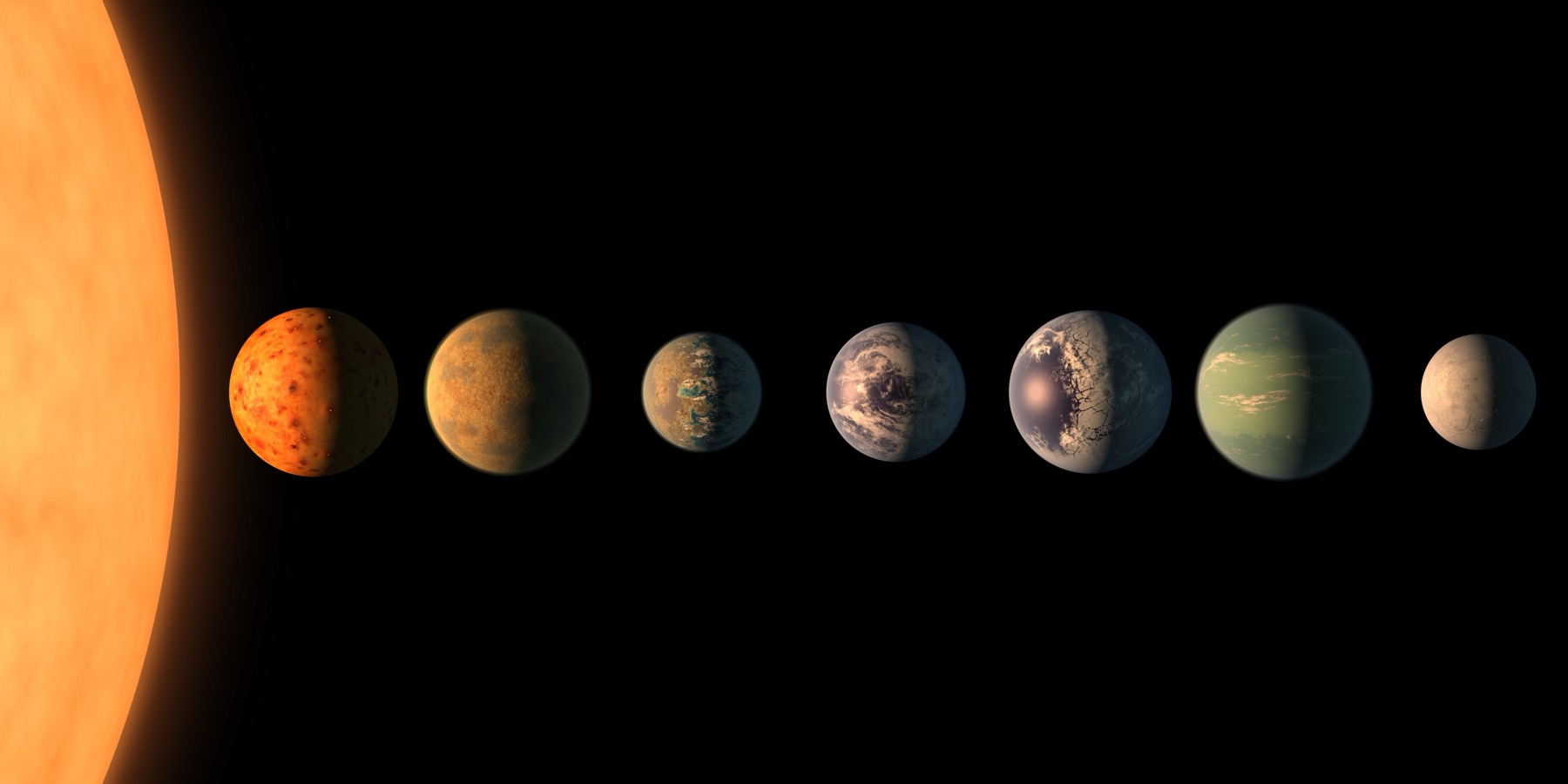
TRAPPIST-1 is a small, cool red dwarf star about 40 light-years away with seven rocky, roughly Earth-sized planets, three of them in its habitable zone. Announced in 2017, it is the best natural laboratory for asking whether rocky planets around small stars can keep atmospheres. JWST has found the two innermost planets airless or nearly so; the habitable-zone planet TRAPPIST-1 e is still undecided.
For how planets like these are found and counted, see our exoplanets guide.
What is TRAPPIST-1?
TRAPPIST-1 is an ultracool dwarf star of spectral type M8, with about 9% of the Sun’s mass, a radius only slightly larger than Jupiter’s and a surface temperature around 2,570 K (NASA Exoplanet Archive). It is about 7.6 billion years old (Burgasser and Mamajek 2017), probably older than the Sun.
In February 2017 Michaël Gillon and colleagues reported in Nature that the star has at least seven transiting planets with sizes and masses similar to Earth’s (the TRAPPIST-1 discovery paper). NASA’s Spitzer Space Telescope was central to the observations.
The seven TRAPPIST-1 planets
All seven orbit closer to their star than Mercury does to the Sun. Because the star is so dim, the outer ones are still temperate.
| Planet | Orbit (days) | Radius (Earth = 1) | Mass (Earth = 1) | Equilibrium temperature | JWST status (October 2026) |
|---|---|---|---|---|---|
| b | 1.51 | 1.12 | 1.37 | 398 K | No thick atmosphere; bare rock or thin hazy CO2 |
| c | 2.42 | 1.10 | 1.31 | 340 K | No thick CO2 atmosphere; at most a thin one |
| d | 4.05 | 0.79 | 0.39 | 286 K | No clear hydrogen atmosphere; any air very thin or hazy |
| e | 6.10 | 0.92 | 0.69 | 250 K | No hydrogen atmosphere; CO2-rich unlikely; nitrogen-rich or bare rock possible |
| f | 9.21 | 1.05 | 1.04 | 218 K | Not yet characterized |
| g | 12.35 | 1.13 | 1.32 | 197 K | Not yet characterized |
| h | 18.77 | 0.76 | 0.33 | 172 K | Not yet characterized |
Orbits, sizes, masses and temperatures from Agol et al. 2021 (Planetary Science Journal), as listed by the NASA Exoplanet Archive. Equilibrium temperature assumes no atmosphere and no greenhouse effect.
The masses are known to 3 to 5%, measured from tiny shifts in transit times as the planets tug on one another. Agol and colleagues found that all seven fit a single rocky composition, slightly less dense than Earth: about 21% iron by weight, versus 32% for Earth. NASA summarized it as planets “made of similar stuff”, with densities differing by no more than 3%.
Which planets could be habitable?
NASA places TRAPPIST-1 e, f and g in the habitable zone, the range of distances where a rocky planet with a suitable atmosphere could keep liquid water. TRAPPIST-1 e receives starlight closest to Earth’s and is the focus of most atmosphere searches; f and g are colder and would need thicker greenhouse atmospheres. For how e compares with other candidates, see our list of the most Earth-like exoplanets.
The catch is the star. Red dwarfs flare often and stay active for billions of years, and the planets sit close enough to be tidally locked, one face always toward the star. Whether they could keep air at all is the question JWST was built to start answering.
What has JWST found?
JWST has studied the system since its first year of science, using two methods: measuring the heat from a planet’s dayside as it passes behind the star, and reading starlight filtered through its air during transits. The results so far, from the inside out:
- TRAPPIST-1 b (2023 and 2024). Greene and colleagues measured its dayside at about 500 K, roughly 230 °C, with no sign of a significant atmosphere (Nature, 2023). A 2024 follow-up by Ducrot and colleagues (Nature Astronomy) found the data fit either bare rock with a fresh surface or a thick carbon dioxide atmosphere with high-altitude haze.
- TRAPPIST-1 c (2023). Zieba and colleagues found a dayside brightness temperature of about 380 K, ruling out a thick, Venus-like carbon dioxide atmosphere (Nature, 2023).
- Phase curves of b and c (2025). A study led by Michaël Gillon, accepted by Nature Astronomy, followed the planets around their orbits and ruled out dense greenhouse atmospheres on both: b probably has little or no air, while c could keep at most a tenuous one.
- TRAPPIST-1 d (2025). The first full NIRSpec spectrum, from a study accepted by The Astrophysical Journal, showed no molecular absorption and excluded a clear hydrogen-rich atmosphere; any air is extremely thin or hidden by high clouds.
- TRAPPIST-1 e (2025). Two papers published in September 2025 in The Astrophysical Journal Letters (Espinoza et al. and Glidden et al.) used four transits. They ruled out a primary, hydrogen-rich atmosphere and found a carbon dioxide-dominated one unlikely. A nitrogen-rich atmosphere with trace gases, like Earth’s, still fits, and so does bare rock.
JWST’s results are consistent with a growing picture that the inner planets of red dwarfs struggle to hold on to air. The results also show how hard the measurement is: the star’s spots and flares imprint signals on the spectra that can mimic or hide an atmosphere.
What comes next for TRAPPIST-1 e
A JWST program is observing about 15 more transits of TRAPPIST-1 e, timed so that the airless planet b transits just before or after it. Because b has no atmosphere, its transit records the star’s own contamination, which can then be subtracted from e’s. The program description, accepted by The Astronomical Journal, says 15 such transits could detect an Earth-like atmosphere with carbon dioxide if one is there. The first observations were complicated by stellar flares, and no detection has been claimed as of October 2026.
The outer planets f, g and h are harder still: a 2026 preprint, not yet peer reviewed, found archival JWST data not sensitive enough to distinguish bare rock from an atmosphere on them. For the nearest temperate planet of all, which does not transit and so cannot be studied this way, see our explainer on Proxima b. For the life question in general, see our astrobiology guide.
Questions people ask
How far away is TRAPPIST-1?
About 40 light-years, or 12.4 parsecs. NASA puts it at about 235 trillion miles, roughly 380 trillion kilometers. That is close by galactic standards, which is why its planets can be studied in such detail, but far beyond the reach of any spacecraft we could build today.
How many planets does TRAPPIST-1 have?
Seven known planets, named b through h from the inside out. All are roughly Earth-sized, with radii between about 0.76 and 1.13 times Earth's, and all orbit closer to their star than Mercury does to the Sun, taking between 1.5 and 18.8 days per orbit. They were announced together in February 2017.
Which TRAPPIST-1 planets are in the habitable zone?
NASA counts three: TRAPPIST-1 e, f and g, which receive amounts of starlight that could allow liquid water on their surfaces if they have suitable atmospheres. TRAPPIST-1 e, with an equilibrium temperature near 250 K before any greenhouse warming, is usually considered the most promising of the seven.
Does TRAPPIST-1e have an atmosphere?
Not yet known. JWST observations published in September 2025 showed that TRAPPIST-1 e no longer has its original hydrogen-rich atmosphere and that a carbon dioxide-dominated one is unlikely. A nitrogen-rich atmosphere like Earth's, or bare rock, both still fit the data. More than a dozen further transits are being observed.
Could there be life on TRAPPIST-1 planets?
There is no evidence either way. The outer planets could hold liquid water if they kept atmospheres, but their star is an active red dwarf whose flares may strip air away, and JWST has found the two innermost planets airless or nearly so. Whether e, f or g are different is the key open question.
How old is TRAPPIST-1?
About 7.6 billion years, plus or minus 2.2 billion, according to a 2017 study by Burgasser and Mamajek in The Astrophysical Journal. That makes the system probably older than the Sun, which is about 4.6 billion years old. Its planets have had billions of years of exposure to their star's activity.