Proxima b
Proxima b is the nearest known exoplanet: a rocky world of about one Earth mass in the habitable zone of a flaring red dwarf 4.24 light-years away.
By The Orbital Record editorial teamPublished Last reviewed
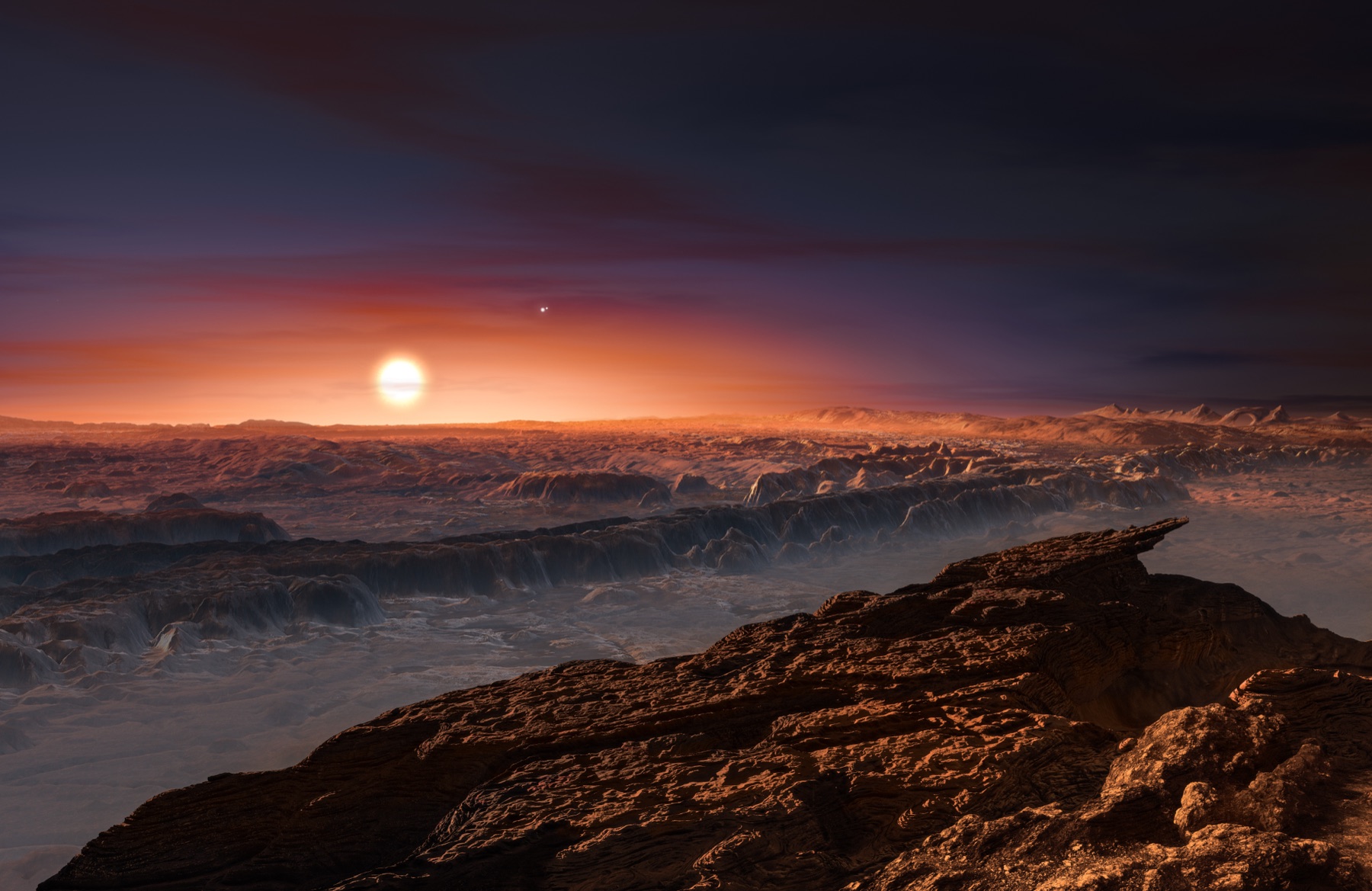
Proxima b is the nearest known exoplanet: a planet of about one Earth mass orbiting Proxima Centauri, the closest star to the Sun, 4.24 light-years away. It circles its small red dwarf every 11.2 days inside the habitable zone, where liquid water could exist. Discovered in 2016, it is probably rocky, but nobody knows yet whether it has an atmosphere.
Proxima b is the best-known example of a common kind of world: a temperate, Earth-mass planet around a red dwarf. For the wider picture of how planets like it are found, see our exoplanets guide.
Proxima b at a glance
| Property | Value | Source |
|---|---|---|
| Distance | 4.24 light-years (1.30 parsecs) | NASA; NASA Exoplanet Archive |
| Host star | Proxima Centauri, a red dwarf of 0.12 solar masses, about 2,900 K | NASA Exoplanet Archive |
| Minimum mass | 1.055 Earth masses (plus or minus 0.055) | NIRPS, 2025 |
| Orbital period | 11.2 days | NIRPS, 2025 |
| Distance from star | 0.048 au, about 7 million km (5% of the Earth-Sun distance) | ESO; NIRPS, 2025 |
| Equilibrium temperature | About 218 K (minus 55 °C), before any greenhouse effect | NASA Exoplanet Archive |
| Radius | About 1.02 Earth radii (a model estimate, never measured) | NASA |
| Discovered | 2016, radial velocity method | Anglada-Escudé et al. 2016 |
The “minimum mass” caveat matters. The radial velocity method measures how hard a planet tugs on its star along our line of sight, so it gives a lower limit that depends on the unknown tilt of the orbit. The true mass is probably close to it but could be larger.
How was Proxima b discovered?
Proxima b was found in 2016 by the Pale Red Dot campaign, led by Guillem Anglada-Escudé, then at Queen Mary University of London (the Proxima b discovery paper). The team used the HARPS spectrograph on ESO’s 3.6-meter telescope at La Silla in Chile, supported by brightness monitoring from smaller telescopes, to watch Proxima Centauri’s light shift back and forth in a regular rhythm.
The star moves toward and away from Earth every 11.2 days at about walking pace. The paper, published in Nature in August 2016, reported a planet of at least 1.3 Earth masses about 0.05 au from its star. Because Proxima Centauri is so faint and cool, that tight orbit falls inside its habitable zone, the range of distances where a planet could hold liquid water on its surface (how habitable zones are defined).
Later instruments refined the numbers. ESO’s ESPRESSO spectrograph on the Very Large Telescope confirmed the planet in 2020, and NIRPS, a near-infrared spectrograph, brought the minimum mass down to 1.055 Earth masses in a study published in 2025.
Is Proxima b habitable?
Proxima b is in the habitable zone, but that only means the temperature could allow liquid water. Three problems make its real habitability uncertain:
- Flares. Proxima Centauri is a violent flare star. In March 2016 a superflare made it about 68 times brighter in visible light, and observers estimated at least five such superflares a year (Howard et al. 2018). In May 2019 astronomers caught the brightest flare ever recorded from it in millimeter and far-ultraviolet light, more than 14,000 times brighter in the far ultraviolet for a few seconds (MacGregor et al. 2021). Repeated flares could strip an atmosphere or destroy an ozone layer.
- Tidal locking. A planet this close to its star is expected to keep one face permanently toward it, with a hot dayside and a frozen nightside, unless a thick atmosphere or ocean moves heat around.
- Its history. Red dwarfs are extremely bright and active when young, long before they settle down. A planet in today’s habitable zone may have lost its water early on.
None of these rules life out. They are the reasons the question “Can planets around red dwarfs keep their air?” is one of the central problems in astrobiology.
Can we see Proxima b’s atmosphere?
Not yet. Most exoplanet atmospheres, including those JWST has studied, are read during transits, when a planet crosses in front of its star and starlight filters through its air. Proxima b does not transit. Searches with the MOST satellite in 2016 and with Spitzer, published in 2019, found no transit, and the Spitzer data ruled one out.
As of October 2026 no telescope has measured Proxima b’s atmosphere or its heat directly. Doing so will need either very precise measurements of the planet’s thermal glow as it orbits, or direct imaging with the next generation of giant ground-based telescopes, such as ESO’s Extremely Large Telescope, expected to begin science in December 2030.
Proxima d and Proxima c
Proxima b has at least one confirmed sibling:
- Proxima d, announced by ESO in February 2022 from ESPRESSO data, has a minimum mass of about a quarter of Earth’s and orbits in just 5.1 days, about 4 million kilometers from the star. NIRPS confirmed it in 2025. When it was announced, ESO called it the lightest exoplanet ever measured with the radial velocity technique.
- Proxima c, proposed in 2020, would be a cold planet of about 6 Earth masses on a five-year orbit. NASA’s Exoplanet Archive lists it as a candidate, and the 2025 NIRPS study found inconclusive evidence for its signal. Treat it as unconfirmed.
For how Proxima b compares with TRAPPIST-1 e, TOI-700 d and other candidates, see our ranking of the most Earth-like exoplanets, and for another nearby red dwarf system, our explainer on TRAPPIST-1.
Could we ever go there?
At 4.24 light-years, about 40 trillion kilometers, Proxima b is the closest target any interstellar mission could have. With today’s spacecraft, the trip would take many thousands of years. For now, the realistic path is better telescopes: precise spectrographs to pin down its mass, and giant telescopes that may one day separate its faint light from its star’s.
Questions people ask
How far away is Proxima b?
About 4.24 light-years, the distance to its star, Proxima Centauri, the closest star to the Sun. That is roughly 40 trillion kilometers. Even the fastest spacecraft launched so far would need thousands of years to get there, so for now Proxima b can only be studied with telescopes from Earth and space.
Can humans live on Proxima b?
Nobody knows, and it is far beyond reach anyway. Proxima b gets a similar amount of energy from its star as Earth gets from the Sun, so liquid water is possible in principle. But its star bombards it with flares, it is probably tidally locked, and we do not know whether it has an atmosphere at all.
Does Proxima b have an atmosphere?
Unknown as of October 2026. Proxima b does not pass in front of its star as seen from Earth, so astronomers cannot use the transit method that JWST relies on to read atmospheres. Whether repeated superflares from Proxima Centauri have stripped away any air is one of the main open questions about the planet.
How was Proxima b discovered?
Through the radial velocity method. In 2016 the Pale Red Dot campaign, led by Guillem Anglada-Escudé, used the HARPS spectrograph on ESO's 3.6-meter telescope at La Silla to detect Proxima Centauri wobbling toward and away from Earth every 11.2 days, the pull of an orbiting planet of at least about one Earth mass.
Is Proxima b bigger than Earth?
Probably about the same size, but its size has never been measured directly. Its minimum mass is about 1.06 Earth masses, according to 2025 measurements with the NIRPS spectrograph. NASA's catalog estimates a radius of about 1.02 times Earth's, a model value. If it is rocky, it is very close to Earth in size.
How many planets orbit Proxima Centauri?
Two are confirmed as of October 2026: Proxima b, in the habitable zone, and Proxima d, a small planet of about a quarter of Earth's mass on a 5.1-day orbit, confirmed in 2025. A third, Proxima c, a possible cold super-Earth on a five-year orbit, remains an unconfirmed candidate.